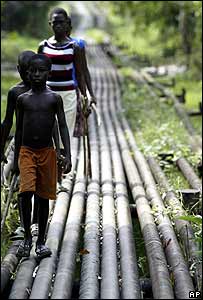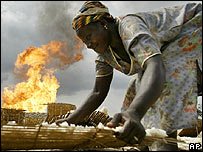
Despite the money generated from oil, many people still live in poverty

Experts have been sent to the commercial chicken farm in Jaji, in Kaduna state, where bird flu was found.
Authorities there said they had taken measures to stamp out the outbreak by disinfecting the affected premises, imposing a quarantine and putting restrictions on animal movements.
Dr Nabarro, who is leading the UN's response to bird flu, said reports from Nigeria's ministry of agriculture suggested bird flu may also have been found in the northern state of Kano and further south in Joss....
Experts have long feared that if H5N1 reached Africa, it could quickly take hold and spread out of control.
Dr Alex Thiermann of the Paris-based World Organisation for Animal Health told the BBC that Africa's "veterinary infrastructures are very weak"....
Nigeria says it will cull all infected birds and compensate farmers.
But a northern Nigerian farmer told the BBC News website that people fear they will not be paid.
"The dead birds are being sent to market to be sold as meat... because people are not sure if the government will assist them," said Auwalu Haruna from Kano.
The lenses make objects appear sharper by eliminating 90 percent of blue light -- the primary component in "visual noise." Then, in a process Nike calls "light architecture," MaxSight manipulates the brightness and hue of the remaining light transmitted through the lens. The result is improvement of visual acuity. The seams on baseballs are sharper, images in shadows are more clear, and every blade of grass has definition.
"There is a dramatic 'wow’ effect when you put them on," says Reichow.
For all these reasons, outside observers might be forgiven for thinking that political Islam, in various violent forms, was on the march against the West. In fact, the Islamist movement, though it may look monolithic from afar, is highly quarrelsome and diverse, and in many ways its internal divisions are deepening.
By no means everybody in the Muslim world rejoiced at the Hamas victory. It was disturbing in at least two different quarters. One was the corridors of power in Arab states, such as Jordan and Egypt, where the Brotherhood is already a powerful grass-roots movement and is steadily gaining confidence. In Egypt's partially-free elections last November, the Brotherhood did far better than expected; and in Jordan, where the Brothers have long been treated as an innocuous vent for letting off anti-Israel and anti-western steam, the movement is demanding a higher profile.
Even more dismayed by the Hamas victory, it seems, are the al-Qaeda terrorist network and its sympathisers. They were already furious with Hamas for compromising with secular liberal ideas by taking part in multi-party elections, and the fact that Hamas has played the democratic game rather successfully will only increase their dismay.
Here lies a paradox. The two best known forms of political Islam (broadly speaking, al-Qaeda and the Brotherhood) have common ideological origins. Both have their roots in the anti-secular opposition in Egypt, a conservative reading of Sunni Islam and the wealth and religious zeal of the Saudis. But they differ hugely over politics and tactics....
Observing the ideological fights between al-Qaeda and the Brotherhood, and the physical fights between Sunnis and Shias, some American strategists might ask themselves: since they all oppose us and our allies, shouldn't we take comfort from the fact that they hate each other too?
In reality, things don't work that way. However little the arcana of Sunni or Shia theology are understood in Peoria or even in Washington, DC, the hard fact is that the American occupation of Iraq has made it appear, to many people in the Middle East, that America is now the main arbiter in the balance of power between the different components of the Islamic world. To put it another way, people who were already inclined to see almost every development in the Islamic world as America's work will be harder to dissuade.
On Friday the State Department found it appropriate to intervene. It blasted the publication of the cartoons as unacceptable incitement to religious hatred. It is a peculiar moment when the government of the United States, which likes to see itself as the home of free speech, suggests to European journalists what not to print.
The writer is Washington bureau chief of the German newsweekly Die Zeit.
Worse, all the horrors that we've already seen in Darfur may be remembered only as the prelude. Security in the region is deteriorating, African Union peacekeepers are becoming targets, and the U.N. has warned that if humanitarian agencies are forced out, the death toll may rise to 100,000 per month.
Just as dangerous, the government-supported janjaweed — the brutal militia responsible for the slaughter — is now making regular raids across the border into Chad. There is a growing risk that Chad will collapse into war as well, hugely increasing the death toll and spreading chaos across a much larger region.
Last week, the United Nations agreed to plan for an international force. It will be nice if the force materializes — but even that half-step is probably almost a year away. The solution isn't American ground forces, but a starting point would be American resolve to put genocide at the top of the international agenda. Unfortunately, Mr. Bush barely lets the word "Darfur" past his lips.
The best way for President Bush to honor Coretta Scott King isn't simply to recite platitudes at her funeral today, but to push loudly and forcefully to stop genocide. Was the essential message of the Rev. Martin Luther King Jr. about the need to be seen at funerals? Or about standing up to injustice, like a genocide in which infants are grabbed from their mothers' arms and tossed onto bonfires?
The reality is that the only way the White House will move on Darfur is if it is flooded with calls from the public — and that will happen only when the genocide is brought home to living rooms around America.
According to the Tyndall Report, which analyzes the content of the evening newscasts of the broadcast networks, their coverage of Darfur actually declined last year. The total for all three networks was 26 minutes in 2004. That wasn't much — but it dropped to just 18 minutes during all of 2005.
ABC's evening news program had 11 minutes about Darfur over the year, NBC's had 5 minutes, and CBS's found genocide worth only 2 minutes of airtime during the course of 2005.
In contrast, the networks gave the Michael Jackson trial in 2005 a total of 84 minutes of coverage. There aren't comparable figures for cable networks like Fox, but Mr. O'Reilly and other cable newscasters pretty much ignored the Darfur catastrophe.
Mr. O'Reilly has a big audience and a knack for stirring outrage. Lately, he (quite properly) galvanized an outcry over a ridiculously light sentence for a sexual predator in Vermont. The upshot was that the sentence was increased. Good stuff!
So imagine the furor Mr. O'Reilly could stir up if he publicized the hundreds of thousands of rapes, murders and mutilations in Darfur. He could save lives on a grand scale.
Join the pledge drive! I'm starting with my own $1,000 pledge to sponsor Mr. O'Reilly's trip. Please help.
All the displaced people I interviewed in camps in Lira, Pader and Gulu described how the LRA's extremes drove them into the camps for protection.
In a typical attack, the LRA strike shortly after dark. When operating deep in northern Uganda, they dress in civilian attire, making them virtually indistinguishable from regular citizens.
They either target a settlement like a village or go for other undefended targets like schools. In Lira district, the LRA once attacked Aboke Girls Secondary School and abducted 139 girls....
In a typical attack, the LRA strike shortly after dark. When operating deep in northern Uganda, they dress in civilian attire, making them virtually indistinguishable from regular citizens.
They either target a settlement like a village or go for other undefended targets like schools. In Lira district, the LRA once attacked Aboke Girls Secondary School and abducted 139 girls.
Once the target has been secured, the rebel commander rounds up all captives and make his selection. The rest are either shot or let loose with debilitating injuries.
Terrorising the population is not the main reason for the massacres. The attacks are accompanied by abductions. This is LRA's preferred mode of recruitment.
Boys and girls as young as six are dragged at gun point from their homes and schools at night and forced to join the rebel ranks.
A former LRA commander explained that children are easier to mould into vicious, soulless fighters than adults with more developed mindsets.
The girls double up as fighters and wives of the LRA commanders. Janet, a former captive and sex-slave of rebel leader Joseph Kony, told me that the LRA commander has taken at least 60 such girls as wives.
The training starts early. Children are methodically turned into remorseless killing machines soon after capture. Some are forced to kill their own kin.
Christine Akello, who was abducted at 12, says she watched as the rebels beat her father unconscious. The rebel commander then forced her to kill her uncle or she would be killed as well. She had to beat him to death. It was the first of her many killings in the seven years she served as an LRA fighter.
Patrick Oneka described how he was forced to kill his little brother, Joseph, because the boy could not keep up with the pace and had tried to escape.
In an emotionless tone, Patrick recounted how he was handed an axe and forced to split the head of the boy he was supposed to protect.
|
And George Opiyo, then 12, recalled how he was ordered to kill his father. The boy at first refused.
The rebels then untied Opiyo's father and ordered him to kill the son. Terrified, George screamed that he would kill his father. He was given a rifle, and he shot his father dead.


 Posts
All Comments
Posts
All Comments