Wednesday, January 27, 2010

The Scales Can Lie: Hidden Fat

New Study Argues Even Thin People Can Face Health Risks From Fat; It's 'Normal Weight Obesity'

Among some of the Mayo Clinic study's findings: High body fat among normal-weight men and women was associated with a nearly four-fold increase in the risk for metabolic syndrome—a cluster of abnormalities including elevated blood sugar and blood pressure. This syndrome is common among people who are obese and is an increasingly important precursor to diabetes and cardiovascular disease. For women, high body fat meant a heightened risk of being diagnosed with cardiovascular disease over the course of the study. Both men and women had a higher risk of abnormal cholesterol and men with high body fat were more likely to develop high blood pressure. 

(..)

The findings of the Mayo study, which was published in November in the European Heart Journal, suggest that reducing heart risk requires increasing the percentage of lean muscle mass at the expense of body fat. That underscores the importance of exercise in maintaining cardiovascular health—including weight lifting and other resistance training, which helps build lean body mass.

Sunday, January 24, 2010

What Could You Live Without?

Another thought provoking editorial from Nicholas Kristof
uvealblues
 While waiting at a traffic light, they saw a black Mercedes coupe on
“Dad, if that man had a less nice car, that man there could have a meal,” Hannah protested. The light changed and they drove on, but Hannah was too young to be reasonable. She pestered her parents about inequity, insisting that she wanted to do something.

“What do you want to do?” her mom responded. “Sell our house?”
Warning! Never suggest a grand gesture to an idealistic teenager. Hannah seized upon the idea of selling the luxurious family home and donating half the proceeds to charity, while using the other half to buy a more modest replacement home.
Eventually, that’s what the family did. The project — crazy, impetuous and utterly inspiring — is chronicled in a book by father and daughter scheduled to be published next month: “The Power of Half.” It’s a book that, frankly, I’d be nervous about leaving around where my own teenage kids might find it. An impressionable child reads this, and the next thing you know your whole family is out on the street.
(..)
“No one expects anyone to sell a house,” said Hannah, now a high school junior who hopes to become a nurse. “That’s kind of a ridiculous thing to do. For us, the house was just something we could live without. It was too big for us. Everyone has too much of something, whether it’s time, talent or treasure. Everyone does have their own half, you just have to find it.”
As for Kevin Salwen, he’s delighted by what has unfolded since that encounter at the red light.
“This is the most self-interested thing we have ever done,” he said. “I’m thrilled that we can help others. I’m blown away by how much it has helped us.”

Sunday, January 17, 2010

Botswana Music Guitar "Muhurutsi"

Our Basic Human Pleasures: Food, Sex and Giving

But in any case, nobility can lead to happiness. Professor Haidt notes that one thing that can make a lasting difference to your contentment is to work with others on a cause larger than yourself.

I see that all the time. I interview people who were busy but reluctantly undertook some good cause because (sigh!) it was the right thing to do. Then they found that this “sacrifice” became a huge source of fulfillment and satisfaction.

Brain scans by neuroscientists confirm that altruism carries its own rewards. A team including Dr. Jorge Moll of the National Institutes of Health found that when a research subject was encouraged to think of giving money to a charity, parts of the brain lit up that are normally associated with selfish pleasures like eating or sex.

Friday, January 15, 2010

A Blind Mother of Two Who Makes Her Own Way

Rahkiya Rawlins, legally blind since birth, has found ways of navigating the world. 
She has a liquid level indicator, which emits a sound when she’s filling a glass and about to reach the brim. When sweeping the floor, she starts from the corners and works her way to the middle, following set choreography because she cannot see the dirt. She has the layout of at least three supermarkets memorized so she can move from aisle to aisle with no surprises.

The Underlying Tragedy


The first of those truths is that we don’t know how to use aid to reduce poverty. Over the past few decades, the world has spent trillions of dollars to generate growth in the developing world. The countries that have not received much aid, like China, have seen tremendous growth and tremendous poverty reductions. The countries that have received aid, like Haiti, have not.
In the recent anthology “What Works in Development?,” a group of economists try to sort out what we’ve learned. The picture is grim. There are no policy levers that consistently correlate to increased growth. There is nearly zero correlation between how a developing economy does one decade and how it does the next. There is no consistently proven way to reduce corruption. Even improving governing institutions doesn’t seem to produce the expected results.

Sunday, January 10, 2010

How lists of the ‘dumb stuff’ can save us from disaster

I am a checklist fanatic and really appreciate Atul Gawande's persistent attempts to push this idea, especially in health care...
Uvealblues

A recent study in the journal Science showed that rats stop thinking and resort to habit when they are under extreme stress. Humans might well do the same.

Nonetheless we appear to believe that in our professional lives, such stress will produce an adrenalin-fuelled surge of clear and brilliant thought. It doesn’t. And in the ensuing muddle, mistakes – sometimes fatal – are made.

Atul Gawande, a surgeon, Harvard Medical School professor and staff writer for The New Yorker, has written a welcome book to convince us of the distinction between un avoidable failures and those we can avert. The Checklist Manifesto is a slim volume but it is packed with vivid writing heart-stopping anecdotes and statistical surprises.

Saturday, January 09, 2010

TRIAGE : Dr. James Orbinski's Humanitarian Dilemma

Medicare and the Mayo Clinic

President Obama last year praised the Mayo Clinic as a "classic example" of how a health-care provider can offer "better outcomes" at lower cost. Then what should Americans think about the famous Minnesota medical center's decision to take fewer Medicare patients?
Specifically, Mayo said last week it will no longer accept Medicare patients at one of its primary care clinics in Arizona. Mayo said the decision is part of a two-year pilot program to determine if it should also drop Medicare patients at other facilities in Arizona, Florida and Minnesota, which serve more than 500,000 seniors.
Mayo says it lost $840 million last year treating Medicare patients, the result of the program's low reimbursement rates. Its hospital and four clinics in Arizona—including the Glendale facility—lost $120 million. Providers like Mayo swallow some of these Medicare losses, while also shifting the cost by charging more to private patients and insurers.
Of course, only governments can lose that much money and pretend they don't have to change. "Mayo Clinic loses a substantial amount of money every year due to the reimbursement schedule under Medicare," the institution said. "Decades of underfunding and paying for volume rather than value in Medicare have led us to this decision."

Mayo is probably a leading indicator of where other hospitals and doctors are headed. Physicians on average earn 20% to 30% less from Medicare than they do from private patients, and many are dropping out of the program. While about 92% of family physicians participate in Medicare, only about 73% of those are now accepting new patients. In some specialties—neurology, oncology, gynecology—in places like Manhattan and Washington, patients can struggle to find any doctor who'll accept Medicare.

7 Secret Benefits Of Exercise

Everybody knows that aerobic exercise builds endurance and strengthens the heart, and strength training builds muscles. But did you know that exercise creates new brain cells? Or that it can help ward off cancer and diabetes? Or that it can keep you from accumulating the wrong kind of body fat?

My colleague David Schardt, senior nutritionist at the Center for Science in the Public Interest, examines the many health benefits of exercise in depth in the current issue of Nutrition Action Healthletter. Here is some of what he found:

Friday, January 08, 2010

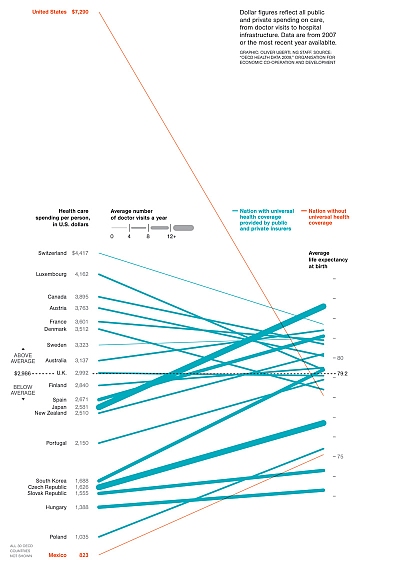
Graphing The Cost of Health Care


Great post on charting cost and outcomes on healthcare in various countries here.. 

The New Chart

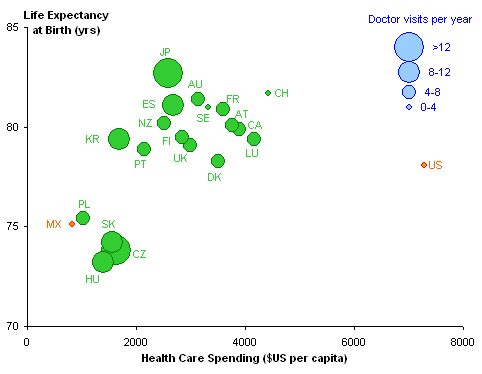
The best way to show correlation between two variables is in an XY chart. I got into Chart Busters mode, and plotted X=spending and Y=life expectancy in the following chart. The US and Mexico are colored differently to highlight their non-universal-coverage status, and data points are sized to reflect the number of doctor visits.

Treat Me, but No Tricks Please

My doctor at the Hospital for Special Surgery in New York, Joseph Feinberg, seems to share my opinion. “Very often, I think the hot packs, cold packs, ultrasound and electrostimulation are unnecessary,” he said, adding, “For sure, in many cases these modalities are a waste of time.”
So has physical therapy been tested for garden-variety sports injuries like tendinosis? Or is it just accepted without much question by people who urgently want to get better?

New Happiness Research From The UK

There’s a new research study out of the UK on what makes people happy, and it has some interesting results.
Related Posts with Thumbnails

ShareThis