Thursday, January 26, 2012

A Scientific Look at the Dangers of High Heels

How shoes affect human gait is a controversial topic these days. The popularity of barefoot running, for instance, has grown in large part because of the belief, still unproven, that wearing modern, well-cushioned running shoes decreases foot strength and proprioception, the sense of how the body is positioned in space, and contributes to running-related injuries.
Whether high heels might likewise affect the wearer’s biomechanics and injury risk has received scant scientific attention, however, even though millions of women wear heels almost every day. So, in one of the first studies of its kind, the Australian scientists recruited nine young women who had worn high heels for at least 40 hours a week for a minimum of two years. The scientists also recruited 10 young women who rarely, if ever, wore heels to serve as controls. The women were in their late teens, 20s or early 30s.
Link

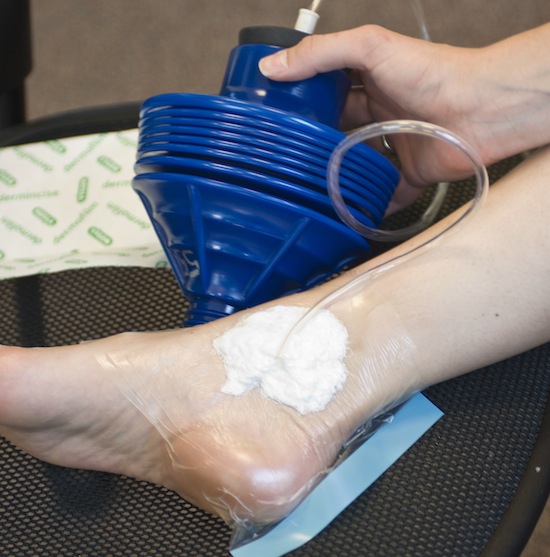
MIT Student Develops $3 Cutting-Edge Healing Device, Field Tested in Haiti

The new device could radically improve healing times for tens of millions, at a cost of $3.
Link
No one really knows why, but for an open wound, simply applying suction dramatically speeds healing times. (The theory is that the negative pressure draws bacteria out, and encourages circulation.) But for almost everyone, that treatment is out of reach--simply because the systems are expensive--rentals cost at least $100 a day and need to be recharged every six hours.
No more. Danielle Zurovcik, a doctoral student at MIT, has created a hand-powered suction-healing system that costs about $3.

NASA’s New Satellite Captures Amazing Hi-Res Image of Earth

You’ve seen Earth, but you’ve never seen it like this.
Suomi NPP, NASA’s newest Earth-watching satellite, has taken a high resolution image of Earth, one of the most beautiful such images ever created. It’s available in 8000×8000 pixel resolution, and it takes a while to download, but it’s definitely worth it.
Link

Tuesday, January 24, 2012

Advanced Cell Technology: Stem cell retinal implants safe

Early results from the world's first human trial using embryonic stem cells to treat diseases of the eye suggest the method is safe, say researchers.
Link
US firm Advanced Cell Technology told The Lancet how two patients who had received the retinal implants were doing well, four months on.
Trials of the same technique have now started at London's Moorfields Eye Hospital.
But experts say it will be years before these treatments are proven.
The aim of these first human studies is to establish that the treatment is safe to use.

Friday, January 20, 2012

Bob Davids and Sea Smoke

Bob Davids is a great guy and he makes my favorite  Pinot on the planet..
Uvealblues
Link

Tuesday, January 17, 2012

For Intrigue, Malaria Drug Gets the Prize

Fascinating article on the history of one of the, if not the, strongest anti Malarials available. Who would have known that Mao Zedong, in a bid to help dying North Vietnamese, commissioned top researchers and herbal healers to find a cure for malaria! 


(Ironically.... Even now in Africa, in almost every country I have been the average person still uses the generally ineffective anti-malarial, Chloroquine..)
Uvealblues

The Chinese drug artemisinin has been hailed as one of the greatest advances in fighting malaria, the scourge of the tropics, since the discovery of quinine centuries ago.

Artemisinin’s discovery is being talked about as a candidate for a Nobel Prize in Medicine. Millions of American taxpayer dollars are spent on it for Africa every year.
But few people realize that in one of the paradoxes of history, the drug was discovered thanks to Mao Zedong, who was acting to help the North Vietnamese in their jungle war against the Americans. Or that it languished for 30 years thanks to China’s isolation and the indifference of Western donors, health agencies and drug companies.

Link

Friday, January 13, 2012

The Richard Feynman Trilogy: The Physicist Captured in Three Films

This is a great find for all fans of Richard Feynman!
Uvealblues


It’s another case of the whole being greater better than the sum of the parts. Between 1981 and 1993, documentary producer Christopher Sykes shot three films and one TV series dedicated to the charismatic, Nobel Prize-winning physicist Richard Feynman (1918-1988). We have presented these documentaries here individually before (some several years ago), but never brought them together. So, prompted by a post on Metafilter, we’re doing just that today.
Link

Wednesday, January 11, 2012

How much Vitamin D is tToo Much?

Too much Vitamin D is associated with lower levels of a marker for cardiovascular inflammation:
C-Reactive Protein
Link

Sunday, January 08, 2012

The Fat Trap


For 15 years, Joseph Proietto has been helping people lose weight. When these obese patients arrive at his weight-loss clinic in Australia, they are determined to slim down. And most of the time, he says, they do just that, sticking to the clinic’s program and dropping excess pounds. But then, almost without exception, the weight begins to creep back. In a matter of months or years, the entire effort has come undone, and the patient is fat again. “It has always seemed strange to me,” says Proietto, who is a physician at the University of Melbourne. “These are people who are very motivated to lose weight, who achieve weight loss most of the time without too much trouble and yet, inevitably, gradually, they regain the weight.”
Anyone who has ever dieted knows that lost pounds often return, and most of us assume the reason is a lack of discipline or a failure of willpower. But Proietto suspected that there was more to it, and he decided to take a closer look at the biological state of the body after weight loss.

Friday, December 16, 2011

Angela Jolie's Directorial Debut

I am looking forward to seeing this!

http://www.vanityfair.com/video/2011/12/1326198072001

Thursday, December 15, 2011

How Coffee Can Galvanize Your Workout

Can a cup of coffee motivate you to relish your trips to the gym this winter? That question is at the heart of a notable study of caffeine and exercise, one of several new experiments suggesting that, whatever your sport, caffeine may allow you to perform better and enjoy yourself more.
Link

Wednesday, December 14, 2011

A short biography of Ron Paul

GREENVILLE, N.C. -- Long before he discovered Friedrich Hayek and other free-market economists, Ron Paul got a lesson in sound money from his oldest brother, Bill.
It was the height of World War II, and the Paul boys were laying aside quarters from their Pittsburgh Press routes and pooling pennies earned from pulling dirty milk bottles off the line at the family dairy to buy war bonds. One day, Ronnie suggested what was, in retrospect, a rather Keynesian solution: "Why doesn't the government just PRINT this money?"
"Well," Bill responded, "then the money wouldn't have any value."
Link

Tuesday, December 13, 2011

Losing 'Virginity': Olive Oil's 'Scandalous' Fraud

Extra-virgin olive oil is a ubiquitous ingredient in Italian recipes, religious rituals and beauty products. But many of the bottles labeled "extra-virgin olive oil" on supermarket shelves have been adulterated and shouldn't be classified as extra-virgin, says New Yorker contributor Tom Mueller.
Mueller's new book, Extra Virginity: The Sublime and Scandalous World of Olive Oil, chronicles how resellers have added lower-priced, lower-grade oils and artificial coloring to extra-virgin olive oil, before passing the new adulterated substance along the supply chain. (One olive oil producer told Mueller that 50 percent of the olive oil sold in the United States is, in some ways, adulterated.)
Link

MIT builds camera that can capture at the speed of light (video)

A team from the MIT media lab has created a camera with a "shutter speed" of one trillion
exposures per second -- enabling it to record light itself traveling from one point to another. Using a heavily modified Streak Tube (which is normally used to intensify photons into electron streams), the team could snap a single image of a laser as it passed through a soda bottle.
Link

Monday, December 12, 2011

Monday, December 05, 2011

Vascular condition and MS share risk factors

People with a specific vascular condition, but no known neurological disease, display many of the same risk factors as people with multiple sclerosis, a new study shows.
Link
The study, published in PLoS One, is the first to investigate risk factors for chronic cerebrospinal venous insufficiency (CCSVI ) in which blood flow from the central nervous system to the periphery is impaired. It has been hypothesized that this narrowing of veins restricts blood flow from the brain, altering brain drainage and possibly contributing to brain tissue injury that is associated with MS.
(..)

Common risk factors
The study found that CCSVI risk factors occurred more frequently in 1) those with a history of mononucleosis, i.e. infected with Epstein-Barr virus; 2) those with irritable bowel syndrome; 3) those who smoke or have a history of smoking.
“All three are confirmed risk factors for MS,” says second author Bianca Weinstock-Guttman, professor of neurology. According to the results, individuals with CCSVI were 2.7 times more likely than individuals without CCSVI to have infectious mononucleosis, 3.9 times more likely to have irritable bowel syndrome and 1.98 times more likely to have a history of smoking.
“Our finding that a risk factor that is highly significant for MS—Epstein-Barr virus, indicated by a history of infectious mononucleosis—is strongly associated with CCSVI, is important,” says Zivadinov. “This is the first time a connection has been found between Epstein-Barr virus and CCSVI.

Sunday, December 04, 2011

The Life Reports II

From David Brooks of the NY TIMES:
A few weeks ago, I asked people over 70 to send me “Life Reports” — essays about their own lives and what they’d done poorly and well. They make for fascinating and addictive reading, and I’ve tried to extract a few general life lessons: Link

Gifts That Say You Care

GIVE Grandma a bit of credit! These holidays, would she rather receive a silly reindeer sweater or help a schoolchild acquire glasses to see the blackboard clearly for the first time?


Choosing the perfect holiday gift is one of life’s greater challenges, modestly more difficult than earning a Ph.D. in astrophysics. So it is time for my annual gift guide.
For starters, the Web sites of the major humanitarian organizations offer alluring holiday gifts. Through the International Rescue Committee, $30 buys a flock of chickens for a needy family. At CARE, $29 gets a girl a school uniform. Through Heifer International, you can stock a fish pond for $300. With Mercy Corps, $69 can start a female entrepreneur in the sewing business.
Beyond those organizations, here are some lesser-known charities that may help put a grin on Grandma — and on someone else.
Helen Keller International

fights blindness and malnutrition around the world with simple and cost-effective programs. One of the best ways to improve children’s health is to focus on micronutrients, like iodine, vitamin A and zinc — and in some cases to fortify foods with nutrients at a negligible cost. Helen Keller International, at hki.org, is a leader in that effort, and gets more bang for the buck than almost any group I can think of.
And those glasses I mentioned for a schoolchild? That’s a Helen Keller International program, ChildSight, which operates in the United States as well as in Indonesia and Vietnam. Schoolchildren are screened for vision problems, and those who need glasses get them. Providing glasses costs just $25 per child — which is a much better value than a sweater that will sit in a drawer for eternity.

12 Things You Didn’t Know Facebook Could Do

As the number of features grows, though, so does a corresponding problem: Most of Facebook’s 750 million users don’t know these features exist. Some don’t know how to find them, some don’t go hunting for them in Facebook’s ever-growing interface of controls and many don’t even think of them in the first place. A few minutes of exploration can uncover functions that make Facebook not just an addiction but a pleasure to use.
Link
Related Posts with Thumbnails

ShareThis