To be the American wife of a Saudi is to forsake familiar freedoms — or enjoy them secretly — in exchange for a secure, family-centered life
Wednesday, January 16, 2008
Pursuing happiness behind the veil
To be the American wife of a Saudi is to forsake familiar freedoms — or enjoy them secretly — in exchange for a secure, family-centered life
Monday, January 14, 2008
Why people believe weird things about money
Would you rather earn $50,000 a year while other people make $25,000, or would you rather earn $100,000 a year while other people get $250,000? Assume for the moment that prices of goods and services will stay the same.
Surprisingly -- stunningly, in fact -- research shows that the majority of people select the first option; they would rather make twice as much as others even if that meant earning half as much as they could otherwise have. How irrational is that?
This result is one among thousands of experiments in behavioral economics, neuroeconomics and evolutionary economics conclusively demonstrating that we are every bit as irrational when it comes to money as we are in most other aspects of our lives. In this case, relative social ranking trumps absolute financial status. Here's a related thought experiment. Would you rather be A or B?
(..)
Consider one more experimental example to prove the point: the ultimatum game. You are given $100 to split between yourself and your game partner. Whatever division of the money you propose, if your partner accepts it, you each get to keep your share. If, however, your partner rejects it, neither of you gets any money.
How much should you offer? Why not suggest a $90-$10 split? If your game partner is a rational, self-interested money-maximizer -- the very embodiment of Homo economicus -- he isn't going to turn down a free 10 bucks, is he? He is. Research shows that proposals that offer much less than a $70-$30 split are usually rejected.
Surprisingly -- stunningly, in fact -- research shows that the majority of people select the first option; they would rather make twice as much as others even if that meant earning half as much as they could otherwise have. How irrational is that?
This result is one among thousands of experiments in behavioral economics, neuroeconomics and evolutionary economics conclusively demonstrating that we are every bit as irrational when it comes to money as we are in most other aspects of our lives. In this case, relative social ranking trumps absolute financial status. Here's a related thought experiment. Would you rather be A or B?
(..)
Consider one more experimental example to prove the point: the ultimatum game. You are given $100 to split between yourself and your game partner. Whatever division of the money you propose, if your partner accepts it, you each get to keep your share. If, however, your partner rejects it, neither of you gets any money.
How much should you offer? Why not suggest a $90-$10 split? If your game partner is a rational, self-interested money-maximizer -- the very embodiment of Homo economicus -- he isn't going to turn down a free 10 bucks, is he? He is. Research shows that proposals that offer much less than a $70-$30 split are usually rejected.
Drug Approved. Is Disease Real?
Fibromyalgia is a real disease. Or so says Pfizer in a new television advertising campaign for Lyrica, the first medicine approved to treat the pain condition, whose very existence is questioned by some doctors.
For patient advocacy groups and doctors who specialize in fibromyalgia, the Lyrica approval is a milestone. They say they hope Lyrica and two other drugs that may be approved this year will legitimize fibromyalgia, just as Prozac brought depression into the mainstream.
But other doctors — including the one who wrote the 1990 paper that defined fibromyalgia but who has since changed his mind — say that the disease does not exist and that Lyrica and the other drugs will be taken by millions of people who do not need them.
For patient advocacy groups and doctors who specialize in fibromyalgia, the Lyrica approval is a milestone. They say they hope Lyrica and two other drugs that may be approved this year will legitimize fibromyalgia, just as Prozac brought depression into the mainstream.
But other doctors — including the one who wrote the 1990 paper that defined fibromyalgia but who has since changed his mind — say that the disease does not exist and that Lyrica and the other drugs will be taken by millions of people who do not need them.
Sunday, January 13, 2008
Blood on Asphalt
Amen...
Reuters runs this story on the Saudi fascination with the video-sharing website YouTube. Now this fascination is not limited to Saudis as YouTube has become an international phenomenon in short time, but as with almost everything else, outsiders seem to think that our country is a piece from outer space and not a part of this world, and anything we do is worthy of attention and newspapers headlines.
The story touches on the dangerous car stunts by Saudi youth that can be found on the site, and quotes a university student saying that teenagers immerse themselves in these acts because they have nothing better to do. This is an excuse I hear so often when people try to explain this stupidity: “they are bored,” I’m told.
I admit it: this country lacks proper entertainment outlets for the youth. There are no cinema theaters, extracurricular activities in schools and universities have little to offer, and sports clubs are poorly managed and can’t cope with the large numbers of youth in this fast growing nation. However, and no matter how many excuses some can come up with to explain why young men here are into cars ‘drifting’, I still think that there is no justification to put the lives of others in danger.
Reuters runs this story on the Saudi fascination with the video-sharing website YouTube. Now this fascination is not limited to Saudis as YouTube has become an international phenomenon in short time, but as with almost everything else, outsiders seem to think that our country is a piece from outer space and not a part of this world, and anything we do is worthy of attention and newspapers headlines.
The story touches on the dangerous car stunts by Saudi youth that can be found on the site, and quotes a university student saying that teenagers immerse themselves in these acts because they have nothing better to do. This is an excuse I hear so often when people try to explain this stupidity: “they are bored,” I’m told.
I admit it: this country lacks proper entertainment outlets for the youth. There are no cinema theaters, extracurricular activities in schools and universities have little to offer, and sports clubs are poorly managed and can’t cope with the large numbers of youth in this fast growing nation. However, and no matter how many excuses some can come up with to explain why young men here are into cars ‘drifting’, I still think that there is no justification to put the lives of others in danger.
Having a Little Work Done (at the Mall)
It still blows me away when I read articles like this....There is so much suffering amongst the billions of people living outside of the U.S. People who can only expect to live to 40 or 50; people--children who die daily because they can't get access to basic medical care. The other side of this is that some patients in America will want this sort of esoteric treatment and happily pay for it. Yet they will be unhappy to pay their copay for a procedure that may save them from blindness. This cosmetic surgery trend brings out the worse in many ways in our healthcare system...It makes me wonder what exactly are "our" priorities...
ANDREW RUDNICK snickered when he first saw a medical spa offering Botox and laser hair-removal services on a visit to a Las Vegas mall in 2002. He laughed at the thought of someone — anyone — shopping for the latest fashions, grabbing a bite to eat and then, oh yeah, strolling in for a quick shot of Botox to zap out a nasty wrinkle.
(..)
Nonsurgical treatments “are effective, they’re safe and they’re affordable — and there’s no down time,” said Dr. Foad Nahai, a plastic surgeon in Atlanta and president of the society.
Some doctors’ offices are joining in. In New York, Dr. Bruce K. Moskowitz, an ophthalmologist and oculofacial plastic surgeon, says demand on the cosmetic side of his business has skyrocketed, to 50 percent of his business, from 25 percent 15 years ago. To meet demand, he opened a medspa in his office; patients in the waiting room can read brochures about Botox and fillers when they come in for eye checkups.
Obesity now a 'lifestyle' choice for Americans, expert says
WASHINGTON (AFP) - As adult obesity balloons in the United States, being overweight has become less of a health hazard and more of a lifestyle choice, the author of a new book argues.
(..)
In "The Fattening of America", published this month, Finkelstein says that adult obesity more than doubled in the United States between 1960 and 2004, rising from 13 percent to around 33 percent.
Globally, only Saudi Arabia fares worse than the United States in terms of the percentage of adults with a severe weight problem -- 35 percent of people in the oil-rich desert kingdom are classified as obese, the book says, citing data from the World Health Organization and Organization for Economic Cooperation and Development.
(..)
In "The Fattening of America", published this month, Finkelstein says that adult obesity more than doubled in the United States between 1960 and 2004, rising from 13 percent to around 33 percent.
Globally, only Saudi Arabia fares worse than the United States in terms of the percentage of adults with a severe weight problem -- 35 percent of people in the oil-rich desert kingdom are classified as obese, the book says, citing data from the World Health Organization and Organization for Economic Cooperation and Development.
Saturday, January 12, 2008
Fine Dining with Mobile Devices
Sage advice for our increasingly interconnected world...
People often say we're multi-tasking ourselves to death. Is that really what we're doing? I think not.
I call what we're doing today continuous partial attention, or cpa, for short.
Continuous partial attention and multi-tasking are two different attention strategies, motivated by different impulses. When we multi-task, we are motivated by a desire to be more productive and more efficient. Each activity has the same priority - we eat lunch AND file papers. We stir the soup AND talk on the phone. With multi-tasking, one or more activities is somewhat automatic, like eating lunch or stirring soup. That activity can be paired with another activity that's automatic or with an activity that requires more cognition, like writing an email or talking on the phone. At the core of multi-tasking is a desire to be more productive. We multi-task to CREATE more opportunity for ourselves -time to DO more and time to RELAX more.
In the case of continuous partial attention, we're motivated by a desire not to miss anything. There's a kind of vigilance that is not characteristic of multi-tasking. With cpa, we feel most alive when we're connected, plugged in and in the know. We constantly SCAN for opportunities - activities or people - in any given moment. With every opportunity we ask, "What can I gain here?"
Our opportunity: remembering to find the OFF switch on our devices, now and then, and tune in to the present with engaged attention.
I believe attention is the most powerful tool of the human spirit. We can enhance or augment our attention with practices like meditation and exercise, diffuse it with technologies like email and Blackberries or alter it with pharmaceuticals. In the end, though, we are fully responsible for how we choose to use this extraordinary tool.
People often say we're multi-tasking ourselves to death. Is that really what we're doing? I think not.
I call what we're doing today continuous partial attention, or cpa, for short.
Continuous partial attention and multi-tasking are two different attention strategies, motivated by different impulses. When we multi-task, we are motivated by a desire to be more productive and more efficient. Each activity has the same priority - we eat lunch AND file papers. We stir the soup AND talk on the phone. With multi-tasking, one or more activities is somewhat automatic, like eating lunch or stirring soup. That activity can be paired with another activity that's automatic or with an activity that requires more cognition, like writing an email or talking on the phone. At the core of multi-tasking is a desire to be more productive. We multi-task to CREATE more opportunity for ourselves -time to DO more and time to RELAX more.
In the case of continuous partial attention, we're motivated by a desire not to miss anything. There's a kind of vigilance that is not characteristic of multi-tasking. With cpa, we feel most alive when we're connected, plugged in and in the know. We constantly SCAN for opportunities - activities or people - in any given moment. With every opportunity we ask, "What can I gain here?"
Our opportunity: remembering to find the OFF switch on our devices, now and then, and tune in to the present with engaged attention.
I believe attention is the most powerful tool of the human spirit. We can enhance or augment our attention with practices like meditation and exercise, diffuse it with technologies like email and Blackberries or alter it with pharmaceuticals. In the end, though, we are fully responsible for how we choose to use this extraordinary tool.
Thursday, January 10, 2008
Jump-Start on Slow Trek to Treatment for a Disease
Last month, the Bill and Melinda Gates Foundation donated $19 million to the Drugs for Neglected Diseases Initiative to further one of its goals: finding a new drug for African sleeping sickness.
(..)
But the gift spotlights just how tricky the search for new treatments can be when the disease is fearsome but nearly forgotten because its victims are poor and obscure.
(..)
“Sleeping sickness” is too benign a nickname for human African trypanosomiasis, which is caused by a protozoan spread by biting tsetse flies. When the parasites enter the brain, victims hallucinate wildly. They have been known to chase neighbors with machetes, throw themselves into latrines and scream with pain at the touch of water. Only at the end do they lapse into a lassitude so great that they cannot eat, followed by coma and death.
About 150,000 people contract the disease each year, but 50 million people in 36 countries live in areas where they are at risk.
The best treatment now is eflornithine, sometimes called the resurrection drug because it can pull the dying out of comas.
It is almost a miracle that eflornithine is available. It was discovered in 1980 at Pace University in New York. By early 2000, the last 7,500 doses in the world were running out. The patentholder, a precursor of the drug maker Sanofi-Aventis, abandoned it in 1995 because it had not lived up to its anticancer potential. Then, in late 2000, plans to make a topical form emerged. It was the key ingredient in Vaniqa, a cream to prevent facial hair in women.
After critics accused Sanofi-Aventis of catering to vain rich women while letting poor Africans die, the company agreed to make an injectable form of the drug and now gives it free to the World Health Organization and Doctors Without Borders.
But in rural Africa, eflornithine is very hard to use. Patients need intravenous infusions four times a day for two weeks. When a “hospital” is a row of iron beds under a thatched roof, and the “nursing staff” is mostly relatives of the sick who sleep on the floor, round-the-clock treatment is hard. There might be no night nurse to insert an IV line.
For that reason, many countries do not adopt it. They still use the drug melarsoprol, which, Dr. Pécoul said, “is not effective and sometimes kills.”
Congress Asks Pfizer: Why Is Dr. Jarvik Qualified To Pitch Lipitor?
Wednesday, January 09, 2008
5o Things I've Learned in 5o years
I esp. liked:
10. Empathy is the greatest virtue. From it, all virtues flow. Without it, all virtues are an act.
11. The Golden Rule is the greatest moral truth. If you don’t believe in it, at least try to fake it.
12. Keeping perspective is the greatest key to happiness. From a distance, even a bumpy road looks smooth.
and
33. The 10-minute jump start is the best way to get going on a big task you’ve been avoiding. Set a timer and begin, promising yourself that you’ll quit after 10 minutes and do something else. The momentum will carry you forward.
50 things I've learned in 50 years, a partial list in no particular order from Chicago Tribune Columnist, Eric Zorn
10. Empathy is the greatest virtue. From it, all virtues flow. Without it, all virtues are an act.
11. The Golden Rule is the greatest moral truth. If you don’t believe in it, at least try to fake it.
12. Keeping perspective is the greatest key to happiness. From a distance, even a bumpy road looks smooth.
and
33. The 10-minute jump start is the best way to get going on a big task you’ve been avoiding. Set a timer and begin, promising yourself that you’ll quit after 10 minutes and do something else. The momentum will carry you forward.
50 things I've learned in 50 years, a partial list in no particular order from Chicago Tribune Columnist, Eric Zorn
Reversal Of Alzheimer's Symptoms Within Minutes In Human Study
ScienceDaily (Jan. 9, 2008) — An extraordinary new scientific study, which for the first time documents marked improvement in Alzheimer’s disease within minutes of administration of a therapeutic molecule, has just been published in the Journal of Neuroinflammation.
(..)
The new study documents a dramatic and unprecedented therapeutic effect in an Alzheimer’s patient: improvement within minutes following delivery of perispinal etanercept, which is etanercept given by injection in the spine. Etanercept (trade name Enbrel) binds and inactivates excess TNF. Etanercept is FDA approved to treat a number of immune-mediated disorders and is used off label in the study.
(..)
The new study documents a dramatic and unprecedented therapeutic effect in an Alzheimer’s patient: improvement within minutes following delivery of perispinal etanercept, which is etanercept given by injection in the spine. Etanercept (trade name Enbrel) binds and inactivates excess TNF. Etanercept is FDA approved to treat a number of immune-mediated disorders and is used off label in the study.
Monday, January 07, 2008
Why They Really Run
A nicely written essay from Michael Kinsley..the concept of keeping one's ambitions under wraps seems to be a peculiar cultural norm applicable to not only politicians but to all of us....
Ladies and gentlemen, they are running because they are ambitious. No, really, they are. You probably suspected as much. And yet you would abandon any candidate who dared to admit this, or at least they all believe that you would. We all are told at our high school graduations to be ambitious, then for the rest of our lives it becomes a shameful secret. Ambition can take many forms. Four decades ago, Norman Podhoretz, the editor of Commentary, created a sensation with a book called Making It that revealed how even intellectuals are ambitious. But the purest form of ambition is political ambition, because it represents a desire to rule over other people.
(..)
The one sin for which redemption and forgiveness are not available is ambition. And yet it's the one sin we know they are all guilty of.
Ladies and gentlemen, they are running because they are ambitious. No, really, they are. You probably suspected as much. And yet you would abandon any candidate who dared to admit this, or at least they all believe that you would. We all are told at our high school graduations to be ambitious, then for the rest of our lives it becomes a shameful secret. Ambition can take many forms. Four decades ago, Norman Podhoretz, the editor of Commentary, created a sensation with a book called Making It that revealed how even intellectuals are ambitious. But the purest form of ambition is political ambition, because it represents a desire to rule over other people.
(..)
The one sin for which redemption and forgiveness are not available is ambition. And yet it's the one sin we know they are all guilty of.
Street Smarts in Bangkok
This article sure brings back great, mouth-watering memories of are many trips to Thailand. If our next vacation,to Myanmar, goes as planned, we will be enjoying similar cuisine. (I am not holding my breath though as my last two trips, Kenya and Cambodia, have both been cancelled). BTW there is a great slide show on the sidebar of the article, capturing the beauty of the food and culture in downtown Bangkok...
A decade ago, when I first moved to Bangkok, a friend who had emigrated there long before me let me in on a secret: the best food in Thailand is served by street vendors and at basic mom-and-pop restaurants. To prove his point, he dragged me to Chote Chitr, tucked into a side alley and decorated with nothing but a wall calendar. I saw no foreigners, and we pored through a menu all in Thai. We sampled the specialties, and I was quickly convinced, eating the same dishes then that I would enjoy 10 years later, and dozens of times in between.
The Falling-Down Professions
While I doubt the great majority of people are going to feel sorry for doctors and lawyers after reading the linked article, I am impressed that it holds the number 1 spot in the most read articles at the New York Times(nytimes.com). The article accurately portrays the great erosion of a sense of satisfaction many individuals in these fields now face in the U.S.
In healthcare the causes are many: the bias towards sensationalism in the media (which distorts the fact that most MDs are bright and caring by focusing on the few that aren't), the insurance companies which demand excessive documentation and then throw out every 3rd or 4th claim for payment submitted by physicians (or so it is said),the rise of consumerism with its attendant demands, the fact that every patient is a potential litigant, the ratio of severe vs. trivial pathology seen in the U.S. (vs. the developing world), the incessant decrease in reimbursement rates which do not allow patients the time they wish to have with their doctors etc...
I was at a dinner recently with 4 doctors--every single one of which was looking for a way to get out of the practice of medicine. In other places I have visited and worked in such as the Far East, the Middle East, and Africa--doctors are accorded much more respect than here. Even though a well--off doctor in say, Jos, Nigeria may only make $500/month I would venture to say that such an indivdual, treated as a professional, is happier in many ways than many of my colleagues here...
I often wonder if the general public realizes how demoralized doctors are here and how many of the brightest minds are now going into alternate fields...
So now who’s going to cheer up the doctors?
As of 2006, nearly 60 percent of doctors polled by the American College of Physician Executives said they had considered getting out of medicine because of low morale, and nearly 70 percent knew someone who already had.
(..)
OR at least, it is not all about money. The pay is still good (sometimes very good), and the in-laws aren’t exactly complaining. Still, something is missing, say many doctors, lawyers and career experts: the old sense of purpose, of respect, of living at the center of American society and embodying its definition of “success.”
(..)
One doctor responding to the American College of Physician Executives survey wrote: “I find it necessary about once every month or two to stay in bed for 24 to 48 hours. I do this on short notice when I get the feeling I might punch somebody.”
Increasing workloads and paperwork might be tolerable if the old feeling of authority were still the same, doctors said. But patients who once might have revered them for their knowledge and skill often arrive at the office armed with a sense of personal expertise, gleaned from a few hours on www.WebMD.com, doctors said, not to mention a disdain for the medical system in general.
(..)
“What irritates me the most is the use of the term ‘provider,’” said Dr. Brian A. Meltzer, an internist in Pennington, N.J., who now practices pro bono on the side, but works full time for Johnson & Johnson’s venture capital division. “We didn’t go to provider school.”
(..)
And then there is, yes, the money issue. Or rather, money envy. Associates at major New York firms often start at $150,000 to $180,000, said Bill Coleman, the chief compensation officer at Salary.com, a company that tracks income statistics. Partners at the country’s biggest 100 firms took home an average of $1.2 million in 2006, according to American Lawyer.
Hardly small sums, but for many senior investment bankers, bonuses and salaries this year will average $2.25 million to $2.75 million, according to Options Group, an executive search and consulting firm.
Doctors rarely approach such heights. While income varies widely, a typical physician might earn $150,00 to $300,000, according to Salary.com data. A surgeon might make $250,000 to $400,000; hot-shot surgeons can earn $750,000 a year, and superstars over a million dollars.
(..)
This star-system mentality is particularly attractive to college students, many of whom were reared with the ’80s philosophy that every child was a potential superstar, Mr. Coleman said. And they want immediate rewards — not exactly the mentality that will fuel a student through years of medical school, a residency and additional training for a specialty.
In healthcare the causes are many: the bias towards sensationalism in the media (which distorts the fact that most MDs are bright and caring by focusing on the few that aren't), the insurance companies which demand excessive documentation and then throw out every 3rd or 4th claim for payment submitted by physicians (or so it is said),the rise of consumerism with its attendant demands, the fact that every patient is a potential litigant, the ratio of severe vs. trivial pathology seen in the U.S. (vs. the developing world), the incessant decrease in reimbursement rates which do not allow patients the time they wish to have with their doctors etc...
I was at a dinner recently with 4 doctors--every single one of which was looking for a way to get out of the practice of medicine. In other places I have visited and worked in such as the Far East, the Middle East, and Africa--doctors are accorded much more respect than here. Even though a well--off doctor in say, Jos, Nigeria may only make $500/month I would venture to say that such an indivdual, treated as a professional, is happier in many ways than many of my colleagues here...
I often wonder if the general public realizes how demoralized doctors are here and how many of the brightest minds are now going into alternate fields...
So now who’s going to cheer up the doctors?
As of 2006, nearly 60 percent of doctors polled by the American College of Physician Executives said they had considered getting out of medicine because of low morale, and nearly 70 percent knew someone who already had.
(..)
OR at least, it is not all about money. The pay is still good (sometimes very good), and the in-laws aren’t exactly complaining. Still, something is missing, say many doctors, lawyers and career experts: the old sense of purpose, of respect, of living at the center of American society and embodying its definition of “success.”
(..)
One doctor responding to the American College of Physician Executives survey wrote: “I find it necessary about once every month or two to stay in bed for 24 to 48 hours. I do this on short notice when I get the feeling I might punch somebody.”
Increasing workloads and paperwork might be tolerable if the old feeling of authority were still the same, doctors said. But patients who once might have revered them for their knowledge and skill often arrive at the office armed with a sense of personal expertise, gleaned from a few hours on www.WebMD.com, doctors said, not to mention a disdain for the medical system in general.
(..)
“What irritates me the most is the use of the term ‘provider,’” said Dr. Brian A. Meltzer, an internist in Pennington, N.J., who now practices pro bono on the side, but works full time for Johnson & Johnson’s venture capital division. “We didn’t go to provider school.”
(..)
And then there is, yes, the money issue. Or rather, money envy. Associates at major New York firms often start at $150,000 to $180,000, said Bill Coleman, the chief compensation officer at Salary.com, a company that tracks income statistics. Partners at the country’s biggest 100 firms took home an average of $1.2 million in 2006, according to American Lawyer.
Hardly small sums, but for many senior investment bankers, bonuses and salaries this year will average $2.25 million to $2.75 million, according to Options Group, an executive search and consulting firm.
Doctors rarely approach such heights. While income varies widely, a typical physician might earn $150,00 to $300,000, according to Salary.com data. A surgeon might make $250,000 to $400,000; hot-shot surgeons can earn $750,000 a year, and superstars over a million dollars.
(..)
This star-system mentality is particularly attractive to college students, many of whom were reared with the ’80s philosophy that every child was a potential superstar, Mr. Coleman said. And they want immediate rewards — not exactly the mentality that will fuel a student through years of medical school, a residency and additional training for a specialty.
Saturday, January 05, 2008
Short, Stout, Has a Handle on Colds
Originally part of a millennia-old Indian yogic tradition, the practice of nasal irrigation — jala neti — is performed with a small pot that looks like a cross between Aladdin’s lamp and your grandmother’s gravy boat. The neti pot made its way into this country in the early 1970s as a yoga meditation device, but even as yoga became mainstream, the neti pot remained on the fringes of alternative culture.
That is, until now. Due to a confluence of influences, the neti pot is having what can only be termed a moment, sold in drugstores, health food stores, even at Wal-Mart and Walgreens.
The practice gained wide exposure last spring when it was introduced on Oprah Winfrey’s show by a frequent guest, Dr. Mehmet Oz, a cardiothoracic surgeon and an author of health books. Dr. Oz explained that bathing the sinus cavities in a warm saline solution can reduce symptoms of allergies, cold, flu and other nasal problems.
Author Comes to Natural Food's 'Defense'
As someone who has been continuously astonished and a bit embarrased by the American contribution of endless varieties of processed foodstuff, marketed as "new and improved food" to the global culinary plate, I found this interview to be a refreshing confirmation of my opposition to processed food...
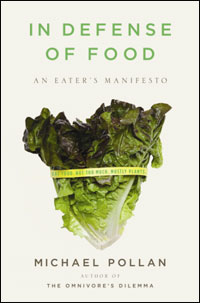
Author Michael Pollan discusses his latest book, In Defense of Food: An Eater's Manifesto. He boils his philosophy of nutrition down to seven words: "Eat food. Not too much. Mostly plants."
What's Tearing Kenya Apart? History, for One Thing
A worthwhile read from this professor of African studies at Harvard...
The immediate cause of the crisis was Kenya's delicate ethnic balance. The incumbent president, Kibaki, is a member of Kenya's largest and probably most powerful ethnic group, the Kikuyu, who total about 22 percent of the population; his rival, Odinga, is a member of the Luo, who comprise some 13 percent of the populace and live predominantly in western Kenya. In their bitter contest, in which Odinga promised to end ethnic favoritism and spread the country's wealth more equitably, ethnicity was the deciding factor, and a marred victory on either side had always been likely to spark violence. Both men are rich, elitist African politicians who have far more in common with each other than they do with their supporters; in their struggle over power, both are using their followers as proxies in a smoldering war. Still, Odinga has a real point about vote tampering; the chief of the E.U. election monitoring mission said that his officials had been turned away from the central vote-counting room in Nairobi, and even Kibaki's hand-picked head of Kenya's electoral commission, Samuel Kivuitu, told reporters that he did "not know whether Kibaki won the election."
Enter Britain, Kenya's former colonial ruler, which now prides itself on being a purveyor of global democracy. Foreign Secretary David Miliband and his U.S. counterpart, Secretary of State Condoleezza Rice, issued a joint statement calling for compromise. Prime Minister Gordon Brown rushed to the phone lines, offering Kibaki and Odinga a quick lesson in democratic principles. In a Kiplingesque touch redolent of the colonial "white man's burden," Brown reportedly told both men, "What I want to see is . . . ." Miliband directed the Kenyan leaders to "behave responsibly."
I doubt that the irony of Brown and Miliband's message was lost on Kibaki or Odinga. Today's Britain, between its botched war on terror and lack of checks on executive power (to name but a few flaws), falls far short of the democratic ideals so paternalistically espoused by Brown and other British leaders. Still, the prime minister's jaw-dropping chutzpah -- on display not only in Kenya but also in former imperial possessions such as Pakistan and Iraq -- is rooted less in Brown's own tin ear than in the nature and structures of yesteryear's British colonial rule. So are today's crises in the former empire. If you're looking for the origins of Kenya's ethnic tensions, look to its colonial past.
Far from leaving behind democratic institutions and cultures, Britain bequeathed to its former colonies corrupted and corruptible governments. Colonial officials hand-picked political successors as they left in the wake of World War II, lavishing political and economic favors on their proteges. This process created elites whose power extended into the post-colonial era.
Added to this was a distinctly colonial view of the rule of law, which saw the British leave behind legal systems that facilitated tyranny, oppression and poverty rather than open, accountable government. And compounding these legacies was Britain's famous imperial policy of "divide and rule," playing one side off another, which often turned fluid groups of individuals into immutable ethnic units, much like Kenya's Luo and Kikuyu today. In many former colonies, the British picked favorites from among these newly solidified ethnic groups and left others out in the cold. We are often told that age-old tribal hatreds drive today's conflicts in Africa. In fact, both ethnic conflict and its attendant grievances are colonial phenomena.
The immediate cause of the crisis was Kenya's delicate ethnic balance. The incumbent president, Kibaki, is a member of Kenya's largest and probably most powerful ethnic group, the Kikuyu, who total about 22 percent of the population; his rival, Odinga, is a member of the Luo, who comprise some 13 percent of the populace and live predominantly in western Kenya. In their bitter contest, in which Odinga promised to end ethnic favoritism and spread the country's wealth more equitably, ethnicity was the deciding factor, and a marred victory on either side had always been likely to spark violence. Both men are rich, elitist African politicians who have far more in common with each other than they do with their supporters; in their struggle over power, both are using their followers as proxies in a smoldering war. Still, Odinga has a real point about vote tampering; the chief of the E.U. election monitoring mission said that his officials had been turned away from the central vote-counting room in Nairobi, and even Kibaki's hand-picked head of Kenya's electoral commission, Samuel Kivuitu, told reporters that he did "not know whether Kibaki won the election."
Enter Britain, Kenya's former colonial ruler, which now prides itself on being a purveyor of global democracy. Foreign Secretary David Miliband and his U.S. counterpart, Secretary of State Condoleezza Rice, issued a joint statement calling for compromise. Prime Minister Gordon Brown rushed to the phone lines, offering Kibaki and Odinga a quick lesson in democratic principles. In a Kiplingesque touch redolent of the colonial "white man's burden," Brown reportedly told both men, "What I want to see is . . . ." Miliband directed the Kenyan leaders to "behave responsibly."
I doubt that the irony of Brown and Miliband's message was lost on Kibaki or Odinga. Today's Britain, between its botched war on terror and lack of checks on executive power (to name but a few flaws), falls far short of the democratic ideals so paternalistically espoused by Brown and other British leaders. Still, the prime minister's jaw-dropping chutzpah -- on display not only in Kenya but also in former imperial possessions such as Pakistan and Iraq -- is rooted less in Brown's own tin ear than in the nature and structures of yesteryear's British colonial rule. So are today's crises in the former empire. If you're looking for the origins of Kenya's ethnic tensions, look to its colonial past.
Far from leaving behind democratic institutions and cultures, Britain bequeathed to its former colonies corrupted and corruptible governments. Colonial officials hand-picked political successors as they left in the wake of World War II, lavishing political and economic favors on their proteges. This process created elites whose power extended into the post-colonial era.
Added to this was a distinctly colonial view of the rule of law, which saw the British leave behind legal systems that facilitated tyranny, oppression and poverty rather than open, accountable government. And compounding these legacies was Britain's famous imperial policy of "divide and rule," playing one side off another, which often turned fluid groups of individuals into immutable ethnic units, much like Kenya's Luo and Kikuyu today. In many former colonies, the British picked favorites from among these newly solidified ethnic groups and left others out in the cold. We are often told that age-old tribal hatreds drive today's conflicts in Africa. In fact, both ethnic conflict and its attendant grievances are colonial phenomena.
Thursday, January 03, 2008
Kenyan Riot Police Turn Back Rioting Protestors
This may put a dent in vacation plans--scheduled to go to Kibera and Kisumu in 3 days...Hmm...
Within the span of a week, one of the most developed, promising countries in Africa has turned into a starter kit for disaster. Tribal militias are roaming the countryside with rusty machetes, neighborhoods are pulling apart, and Kenya’s economy, one of the biggest on the continent, is unraveling — with fuel shortages rippling across East Africa because the roads in Kenya, a regional hub, are too dangerous to use. Roadblocks set up by armed men, something synonymous with anarchic Somalia, have cropped up across the country, in towns on the savannah and in the cramped slums.
(..)
The fighting is especially brutal in the Rift Valley, which is ethnically divided between tribes that support the president and tribes that back the opposition.
In Kiambaa, a village in the Rift Valley about a five-hour drive from Nairobi, the tensions boil down to Kalenjin, the biggest tribe in this area, and Luo, the tribe of Mr. Odinga, versus Kikuyu, Mr. Kibaki’s tribe.
It was Kikuyus who were burned to death on Tuesday in the Kenya Assemblies of God church. The church was simple, made of mud and sticks, and about the size of a tennis court.
(..)
The Kikuyu are Kenya’s biggest tribe at 22 percent of the population. They are concentrated in central Kenya, but because they were the tribe favored by the British during colonial times, they became the privileged class and branched out across the country, running shops, restaurants, banks and factories. In the Rift Valley, many Kikuyus have small businesses and farms.
Wednesday, January 02, 2008
World's Toughest Woman
Ines Ramírez Pérez is a peasant woman living in rural Mexico. She speaks Zapotec but not Spanish and has no medical training. She nevertheless performed a successful caesarean section on herself: both she and her baby survived.
Ramírez was alone in her cabin in Rio Talea, Southern Mexico when her labour started. The nearest midwife was more than 50 miles away over rough terrain and rough roads and her husband was drinking at a cantina. Rio Talea has 500 people and only one phone, but it was not nearby.
At midnight, on 5 March 2000 — after 12 hours of continual pain and little advancement in labour, Ramírez sat down on a bench, drank from a bottle of rubbing alcohol, and used a kitchen knife to cut open her abdomen. Ramírez cut through her skin in a diagonal line from across her stomach to below her navel (a typical C-section incision is well below the navel). After operating on herself for an hour, she reached inside her uterus and pulled out her baby boy. She then severed the umbilical cord with a pair of scissors and became unconscious. When she regained consciousness, she wrapped clothes around her bleeding abdomen and asked her 6-year-old son, Benito, to run for help. Several hours later, the village health assistant found Perez alert and lying beside her live baby. He sewed her 7-inch incision with an available needle and thread. She was eventually taken to the nearest hospital, where two obstetricians examined her and the baby: they found both alive and well but could not explain why.
Describing her experience in her native Zapotec language, Ramírez said, “I couldn’t stand the pain anymore. If my baby was going to die, then I decided I would have to die, too. But if he was going to grow up, I was going to see him grow up, and I was going to be with my child. I thought that God would save both our lives.”
Ramírez was alone in her cabin in Rio Talea, Southern Mexico when her labour started. The nearest midwife was more than 50 miles away over rough terrain and rough roads and her husband was drinking at a cantina. Rio Talea has 500 people and only one phone, but it was not nearby.
At midnight, on 5 March 2000 — after 12 hours of continual pain and little advancement in labour, Ramírez sat down on a bench, drank from a bottle of rubbing alcohol, and used a kitchen knife to cut open her abdomen. Ramírez cut through her skin in a diagonal line from across her stomach to below her navel (a typical C-section incision is well below the navel). After operating on herself for an hour, she reached inside her uterus and pulled out her baby boy. She then severed the umbilical cord with a pair of scissors and became unconscious. When she regained consciousness, she wrapped clothes around her bleeding abdomen and asked her 6-year-old son, Benito, to run for help. Several hours later, the village health assistant found Perez alert and lying beside her live baby. He sewed her 7-inch incision with an available needle and thread. She was eventually taken to the nearest hospital, where two obstetricians examined her and the baby: they found both alive and well but could not explain why.
Describing her experience in her native Zapotec language, Ramírez said, “I couldn’t stand the pain anymore. If my baby was going to die, then I decided I would have to die, too. But if he was going to grow up, I was going to see him grow up, and I was going to be with my child. I thought that God would save both our lives.”
Subscribe to:
Posts (Atom)