Monday, September 06, 2010

New Malaria Drug Candidate Holds Promise

An international team of scientists has identified a promising drug candidate that represents an entirely new class of medicines to treat malaria, one of the biggest killers in the developing world.
(..)

The discovery comes amid two key developments in the fight against the mosquito-borne illness. Several parts of Africa are showing a decline in malaria deaths, thanks to wider use of insecticides and bed nets to ward off mosquitoes that carry the disease, as well as use of artemisinin, a potent drug.
At the same time, there are worrying signs that the malaria parasite in parts of Southeast Asia is becoming resistant to artemisinin, which is the mainstay of combination therapy for as many as 100 million patients world-wide. Resistance has already rendered some older therapies less effective.
"We welcome a new class of drug because it could help us stay one step ahead of the parasite," said Robert Newman, director of the global malaria program at the World Health Organization, who wasn't involved in the Science study.
(..)
The malaria parasite can cause fever, joint pain and death. Last year, there were an estimated 240 million cases of malaria. Of total deaths, 91% occurred in Africa and 85% were children under the age of five, according to the WHO. But the battle against malaria is making progress, and a potent new drug could help sustain the momentum.
AFP/Getty Images
A mosquito on the prowl
In 2009, malaria deaths world-wide fell to 836,000 from more than one million a few years earlier, including declines in Eritrea, Rwanda, Zambia and Zanzibar. Over the past decade, malaria cases have fallen in nine countries in Africa and in 29 elsewhere.

Hair provides proof of the link between chronic stress and heart attack

Researchers at The University of Western Ontario have provided the first direct evidence using a biological marker, to show chronic stress plays an important role in heart attacks. Stressors such as job, marital and financial problems have been linked to the increased risk for developing cardiovascular disease including heart attack. But there hasn't been a biological marker to measure chronic stress. Drs. Gideon Koren and Stan Van Uum developed a method to measure cortisol levels in hair providing an accurate assessment of stress levels in the months prior to an acute event such as a heart attack.

Tuesday, August 31, 2010

A Sikh Temple Where All May Eat, and Pitch In

Anyone making a trip to Northern India, should try to get to Amritsar, to visit the stunning Golden Temple.
Uvealblues

Sikhism, which emerged in the Punjab region of India in the 15th century, strongly rejects the notion of caste, which lies at the core of Hinduism.
The Golden Temple, a giant complex of marble and glittering gold that sits at the heart of this sprawling, hectic city near the border with Pakistan, seeks to embody this principle. Nowhere is it more evident than in the community kitchen, where everyone, no matter his religion, wealth or social status, is considered equal.
Guru Amar Das created the community kitchen during his time as the third Sikh guru in the 16th century. Its purpose, he said, was to place all of humanity on the same plane. At the temple’s museum, one painting shows the wife of one of the gurus serving common people, “working day and night in the kitchen like an ordinary worker,” the caption says.
Volunteerism and community support are other central tenets of Sikhism expressed in the langar. When the Mughal emperor Akbar tried to give Guru Amar Das a platter of gold coins to support the kitchen, he refused to accept them, saying the kitchen “is always run with the blessings of the Almighty.”

Friday, August 27, 2010

Why Fish in the Arctic Don’t Freeze

Scientists studying why fish in the Arctic ocean don’t freeze have discovered how a natural antifreeze that keeps blood flowing at sub-zero temperatures works.
The temperature of the water in the Arctic is a fairly constant 28.6 degrees Fahrenheit year-round, close to the freezing point of seawater. The freezing point of fish blood, however, is about 30.4 degrees Fahrenheit. You’d expect fish traveling beyond a certain latitude to ice up.
Instead, fish are able to keep moving thanks to a frost-protection protein in their blood. It was discovered about 50 years ago, but only now are scientists discovering how the protein works.

(..)
Scientists studying why fish in the Arctic ocean don’t freeze have discovered how a natural antifreeze that keeps blood flowing at sub-zero temperatures works.
The temperature of the water in the Arctic is a fairly constant 28.6 degrees Fahrenheit year-round, close to the freezing point of seawater. The freezing point of fish blood, however, is about 30.4 degrees Fahrenheit. You’d expect fish traveling beyond a certain latitude to ice up.
Instead, fish are able to keep moving thanks to a frost-protection protein in their blood. It was discovered about 50 years ago, but only now are scientists discovering how the protein works.

Thursday, August 26, 2010

Study Restores Damaged Corneas

Scientists have created a new kind of artificial cornea, inserting a sliver of collagen into the eye, coaxing the eye's own natural corneal cells to regrow and restore vision.
(..)
Vision depends on a healthy cornea, the film-like covering of the eye's surface that helps it focus light. Corneas are easily harmed by injury or infection, and about 42,000 people in the U.S. receive transplanted corneas every year. But for many of the estimated 10 million people world-wide with corneal blindness, donated corneas aren't available. And transplants bring risk of rejection.
The new bio-artificial cornea attempts to induce healing by using the same natural substances in a real cornea. "I characterize this work as a major advance in the direction that we need to go," said Alan Carlson, cornea transplant chief at Duke University's eye center, who wasn't involved in the research.
A cornea's structure is made up of tissue called collagen. The researchers took human collagen grown in yeast and molded it into a contact lens-like shape—the scaffolding for a cornea. Dr. Griffith, working with Linkoping University eye surgeon Per Fagerholm, studied the bio-artificial cornea in 10 patients with severe vision loss from corneal damage.

Wednesday, August 18, 2010

An Implantable Antenna

A prototype silk biosensor could someday alert doctors to signs of disease.


Silk and gold, usually a pairing for the runways of Milan, are now the main ingredients for a new kind of implantable biosensor. Researchers at Tufts University have crafted a small antenna from liquid silk and micropatterned gold. The antenna is designed to spot specific proteins and chemicals in the body, and alert doctors wirelessly to signs of disease. Scientists say the implant could someday help patients with diabetes track their glucose levels without having to test themselves daily.
(..)

Omenetto and his colleague Richard Averitt, associate professor of physics at Boston University, used similar principles to create a metamaterial that's responsive not to visible light, but rather to frequencies further down the electromagnetic spectrum, within the terahertz range. Not coincidentally, proteins, enzymes, and chemicals in the body are naturally resonant at terahertz frequencies, and, according to Averitt, each biological agent has its own terahertz "signature."
Terahertz science is a new and growing field, and several research groups are investigating specific protein "T-ray" signatures. A silk metamaterial antenna could someday pick up these specific signals and then send a wireless signal to a computer, to report on chemical levels and monitor disease.

Tuesday, August 17, 2010

Why Girly Jobs Don’t Pay Well


A really good kindergarten teacher is worth $320,000 annually, according to one recent estimate, well publicized in this newspaper. That would reflect the present value of the additional money that students in a really good kindergarten class can expect to earn over their careers.
But average pay for kindergarten teachers is only about $50,380. And even at that level, kindergarten teachers, many employed by public school systems, fare relatively well compared with those in similar jobs.
(..)
As one online discussion of girly jobs explains, some women may just like these jobs despite the low pay.
Some empirical research supports this claim. In a careful analysis oflongitudinal data on earnings that includes survey questions regarding attitudes related to work preferences, Nicole Fortin, at economist at the University of British Columbia, finds that women tend to place less importance on money and more importance on people and family than men do.
(..)
Caring often entails commitments to dependents such as young children, adults with disabilities or the frail elderly who can’t afford to pay directly for the services provided. It doesn’t fit easily into the impersonal logic of fee for service or supply and demand.
Further, caring often creates “outputs” that are not easily captured in market transactions, such as the increases in lifetime capabilities created by excellent kindergarten and preschool teachers.
It’s hard to imagine an explicit contract that could enable a care worker to “capture” the value-added – which extends well beyond increases in lifetime earnings to many less tangible benefits.
Good care helps create – and maintain – good people.
(..)
I agree. And I argue that child care, elder care, education and many social services resemble health care in this respect. They are not commodities that can be efficiently produced by a purely market-based economic system.
What’s striking is the high cost of femininity. Many traits that contribute to women’s success in finding a male partner don’t pay off in the labor market – and vice versa. As one economic analysis of a speed-dating experiment puts it, “Men do not value women’s intelligence or ambition when it exceeds their own.” By contrast, intelligence and ambition contribute to men’s success in both the “dating market” and the labor market.
But men’s attitudes toward women (which are changing, albeit slowly) don’t tell the whole story. Another factor is women’s affinity for services that aren’t rewarded by a market-based economy.

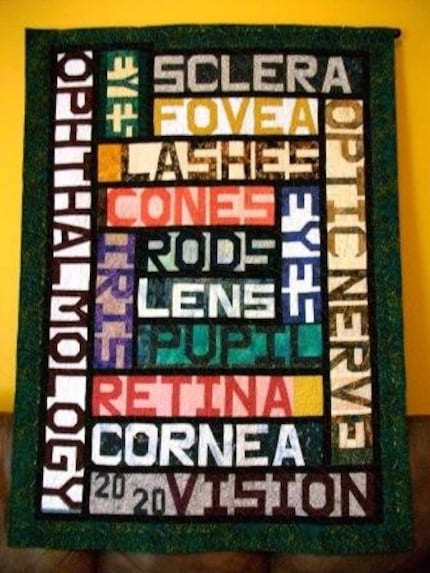
Eye Words Quilt

Ribates has this fantastic quilt up for sale!! (link)
Uvealblues


Looking This Way and That, and Learning to Adapt to the World


The findings provided by these eye-trackers so far (the first light enough for children to wear) suggest that infants may be more capable of understanding and acting on what they see than had been thought. “Quick gazes at obstacles in front of them or at their mothers’ faces may be all they need to get the information they want. They seem to be surprisingly efficient,” said John Franchak, a doctoral candidate in developmental psychology at New York University.

Sunday, August 15, 2010

We Pay Them to Be Rude to Us


A nice editorial from Peggy Noonan at the WSJ

Uvealblues


In the service economy, all of us want to take the chute.

Why has the JetBlue flight attendant story captured everyone's imagination? Because the whole country wants to take the emergency chute.
(..)

But it doesn't strike me as a political story. I think it's a cultural story. American culture is, one way or another, business culture, and our business is service. Once we were a great industrial nation. Now we are a service economy. Which means we are forced to interact with each other, every day, in person and by phone and email. And it's making us all a little mad.
I'm not sure we've fully noted the social implications of the shift from industry to service. We used to make machines! And steel! But now we're always in touch, in negotiation. We interact so much, we wear each other down. We wear away the superego and get straight to the id, and what we see isn't pretty.
Here's why. At the same time we were shifting, in the past 30 years, to the more personal economy of service, we were witnessing and took part in a revolution in manners. We tore them down as too fancy, or sexist, or ageist, or revealing of class biases. Just when we needed more than ever the formality and agreed-upon rules of manners to act as guard rails, we threw them aside. And now no one knows how to act anymore.
The result is that everyone is getting on everyone's nerves. We're all snapping the bins shut on each other's heads. Everyone wants to tell the boss to take this job and shove it. Everyone wants to take a good, hard, last look at the customer and take the chute. (link)

Thursday, August 12, 2010

Temperature Drops Put the Squeeze on Heart Attack Risk


A slight daily mean temperature decline can increase the number of heart attacks for up to a month, new research shows


Temperature extremes have been known to have an ill effect on populations' health and mortality rates. Heat stroke can cause organ failure, and cold weather has been linked to increased hospitalization and death rates. Little firm data exists, however, to draw exacting predictions about how a change in the weather can influence the risk of cardiovascular problems. A new study reveals that even seemingly tiny daily temperature drops have a sizable impact on the number of heart attacks in a large geographic area.

Monday, August 09, 2010

Congregations Gone Wild

With consumerism now causing disaffection in the clergy, as well as education and health care, who is going to take care of all of the "consumers"?? Everyone seems to be burning out!
Uvealblues

THE American clergy is suffering from burnout, several new studies show. And part of the problem, as researchers have observed, is that pastors work too much. Many of them need vacations, it’s true. But there’s a more fundamental problem that no amount of rest and relaxation can help solve: congregational pressure to forsake one’s highest calling.
The pastoral vocation is to help people grow spiritually, resist their lowest impulses and adopt higher, more compassionate ways. But churchgoers increasingly want pastors to soothe and entertain them. It’s apparent in the theater-style seating and giant projection screens in churches and in mission trips that involve more sightseeing than listening to the local people.
As a result, pastors are constantly forced to choose, as they work through congregants’ daily wish lists in their e-mail and voice mail, between paths of personal integrity and those that portend greater job security.
As religion becomes a consumer experience, the clergy become more unhappy and unhealthy.

Sunday, August 08, 2010

Breast Milk Sugars Give Infants a Protective Coat

A large part of human milk cannot be digested by babies and seems to have a purpose quite different from infant nutrition — that of influencing the composition of the bacteria in the infant’s gut.

For American Students, Life Lessons in the Mideast

I am a complete proponent of these study-abroad years. The earlier one can see for oneself what the rest of the world is like, the better for all of mankind.
Uvealblues

AT first glance, they seem like typical American college students on their junior year abroad, swapping stories of language mishaps and cultural clashes, sharing sightseeing tips and travel deals. But these students are not studying at Oxford, the Sorbonne or an art institute in Florence.
Instead, they are attending the American University in Cairo, studying Arabic, not French, and dealing with cultural, social and religious matters far more complex than those in Spain or Italy. And while their European counterparts might head to Heidelberg, Germany, for a weekend of beer drinking, these students visit places most Americans know only through news reports — the West Bank, Ethiopia and even northern Iraq. No “Sex and the City” jaunts to Abu Dhabi for this group.

In what educators are calling the fastest growing study-abroad program, American college students are increasingly choosing to spend their traditional junior year abroad in places like Egypt, Lebanon, Syria, Jordan and the United Arab Emirates, wanting to experience the Arab world beyond America’s borders and viewpoints.

The Weirdest Eyelashes Ever: The Fly-Lash

First there were Christian Dior branded contacts. Then came Lady Gaga’s anime lenses. And we thought there was no way for eye-related products to be any more bizarre. But then we saw these.

We’re all for eyelash enhancement. Fake lashes, lash extensions, lash tinting — why not? But this is not only creepy — it’s flat out disturbing. One young British artist, Jessica Harrison, designed her very own set of fake lashes made entirely out of fly’s legs.


Grossed out yet? Just wait till you see the video.

(via Guy Kawasaki)

Saturday, August 07, 2010

Rebuilding Chrissy's Face

This is an incredibly well done media documentary of a team of volunteer health care professionals in Oregon who painstakingly over a period of time rebuild a girl's face (including her eyes), destroyed from a shotgun blast, via prosthetics.
This should win some kind of media award.Go to the link at Oregonlive here.
Uvealblues


Hat tip to Suture for a Living

There is more information in the AMA news article by Carolyn Krupa here.

How the iPad Can Change Emergency Medicine

A few of you might be reading this on your new iPads. The rest of you are probably sick of the speculation and hype that Apple’s new tablet will transform the publishing world, just as the iPhone changed mobile phones and the iPod revolutionized the music industry.
But a more relevant question for us is: “Can the iPad change the way we work in the emergency department?”

Steve Wynn Takes On Washington (and Healthcare)

Steve Wynn, a casino resort/real-estate developer who has been credited with spearheading the dramatic resurgence and expansion of the Las Vegas Strip, talks about the Fall of America.

Lady Gaga’s claim: Can you actually be an “occasional” cocaine user?

An excellent post on addiction by Doc Gurley...
Uvealblues
The last two days’ news have made it feel like cocaine week: President Obama finally signed a long-overdue law equalizing mandatory sentencing between powder cocaine and crack cocaine users. On a truly tragic note, a 21 year old UC student is reported to be brain damaged and living on life support after lying for three hours unresponsive in a UC Berkeley cooperative house, after suffering an irreversible heart attack, with cocaine and marijuana in his blood. Cocaine is a well-documented cause of heart attacks, even in the very young and healthy. And Lady Gaga apparently told Vanity Fair that she still uses cocaine “occasionally,” adding that she really doesn’t want her fans to follow her example. She also told Rolling Stone about struggling with a drug habit in her past, including a time when she bottomed out in New York “laying in my apartment with bug bites from bedbugs and roaches on the floor and mirrors with cocaine everywhere and no will or interest in doing anything but making music and getting high.”
With cocaine so much in the news, is Lady Gaga right? Can a person – or most people – use cocaine “once or twice a year”? And be fine?

Why The U.S. Will Never Have A Balanced Budget Again

There are some sobering statistics, concisely presented here..
Uvealblues

The United States government will never have another balanced budget again.  Yes, you read that correctly.  U.S. government finances have now reached a critical "tipping point" and things are going to spin wildly out of control from this time forward.
Why?  Spending on entitlement programs and interest on the national debt are now accelerating.  Some time around 2020 they will eat up every single dollar of federal revenue that is brought in before a penny is spent on anything else.  Of course the solution to all of this would be to radically cut entitlement programs, but no U.S. politician in his or her right mind would do that.

Chimpanzee Solving Problem

Check out this neat video highlighting the cognitive skills of this chimpanzee here.

Saturday, July 31, 2010

Eye Words Quilt

Check out the very cool  ophthalmology themed quilt being made by Dr. Bates over at Suture for a Living!

Perspectives

Another great post  here from the South African surgical blog :Other Things Amanzi
via Suture for a Living blog

The Case for $320,000 Kindergarten Teachers

How much do your kindergarten teacher and classmates affect the rest of your life?
Economists have generally thought that the answer was not much. Great teachers and early childhood programs can have a big short-term effect. But the impact tends to fade. By junior high and high school, children who had excellent early schooling do little better on tests than similar children who did not — which raises the demoralizing question of how much of a difference schools and teachers can make.
There has always been one major caveat, however, to the research on the fade-out effect. It was based mainly on test scores, not on a broader set of measures, like a child’s health or eventual earnings. As Raj Chetty, a Harvard economist, says: “We don’t really care about test scores. We care about adult outcomes.”
Early this year, Mr. Chetty and five other researchers set out to fill this void. They examined the life paths of almost 12,000 children who had been part of a well-known education experiment in Tennessee in the 1980s. The children are now about 30, well started on their adult lives.
On Tuesday, Mr. Chetty presented the findings — not yet peer-reviewed — at an academic conference in Cambridge, Mass.
They’re fairly explosive.

Thursday, July 29, 2010

The Breathing Earth Simulation

Welcome to Breathing Earth This real-time simulation displays the CO2 emissions of every country in the world, as well as their birth and death rates.

Wednesday, July 28, 2010

Amazing Voice: 7-Year-Old Gospel Singer Belts Whitney And Celine Songs


YouTube videos of Rhema performing "Amazing Grace," "O Holy Night," Celine Dion's "The Prayer" with Terry White, and Whitney Houston's "I Love The Lord" have generated more than a million streams.
(..)
Rhema began singing when she learned to speak. Her mother, Wendi Marvanne, who was a local gospel singer, died of ovarian cancer in 2008. She often sang with Rhema and rehearsed plays.
As a tribute to her mother, Rhema will focus on gospel music. "Out of my love for [my wife] and out of respect for her wishes I thought Rhema has incredible singing skills and talent, I wanted to do something she would be happy with and follow in her footsteps," Voaritskul said.


What Do You Lack? Probably Vitamin D

Vitamin D promises to be the most talked-about and written-about supplement of the decade. While studies continue to refine optimal blood levels and recommended dietary amounts, the fact remains that a huge part of the population — from robust newborns to the frail elderly, and many others in between — are deficient in this essential nutrient. 
If the findings of existing clinical trials hold up in future research, the potential consequences of this deficiency are likely to go far beyond inadequate bone development and excessive bone loss that can result in falls and fractures. Every tissue in the body, including the brain, heart, muscles and immune system, has receptors for vitamin D, meaning that this nutrient is needed at proper levels for these tissues to function well.
Studies indicate that the effects of a vitamin D deficiency include an elevated risk of developing (and dying from) cancers of the colon, breast and prostate; high blood pressure and cardiovascular disease; osteoarthritis; and immune-system abnormalities that can result in infections and autoimmune disorders like multiple sclerosis, Type 1 diabetes and rheumatoid arthritis.

Thursday, July 22, 2010

U.S. goes from leading to lagging in young college graduates


This can't be good...especially given the fact that we don't have well-defined apprenticeship programs (as is present in many European countries for example) for those who do not get a higher education..
Uvealblues

The United States has fallen from first to 12th in the share of adults ages 25 to 34 with postsecondary degrees, according to a new report from the College Board.
Canada is now the global leader in higher education among young adults, with 55.8 percent of that population holding an associate degree or better as of 2007, the year of the latest international ranking. The United States sits 11 places back, with 40.4 percent of young adults holding postsecondary credentials.

Sunday, July 18, 2010

Stimulation prevents stroke by a whisker


Strokes are the No. 3 cause of death in the United States, after heart disease and cancer, striking about 795,000 Americans each year—more than 137,000 fatally, according to the American Heart Association.
So should we be tickling our own whiskers? And what about women, who are less likely to have facial hair?
While it’s too soon to tell if the findings will translate to humans, researchers say it’s possible, and stubble is not required.
People have sensitive body parts wired to the same area of the brain as rodents’ fine-tuned whiskers.
“Stimulating the fingers, lips or face in general could all have a similar effect,” says Melissa Davis, University of California at Irvine graduate student and co-author of the study, which appears in the June issue of PLoS One.

Bruce Lee Playing Ping Pong With Nunchaku

Thursday, July 15, 2010

Are Designer Sunglasses Worth the Price?

Maybe not, writes Brett Arends. For starters, most shades are made by the same company. Here's what you need to know before buying.

How Microbes Defend and Define Us

This is a fascinating description of a bacterial "transplant."
Here is a quote from the article: We continue to be colonized every day of our lives. “Surrounding us and infusing us is this cloud of microbes,” said Jeffrey Gordon of Washington University.
Uvealblues

In 2008, Dr. Khoruts, a gastroenterologist at the University of Minnesota, took on a patient suffering from a vicious gut infection of Clostridium difficile. She was crippled by constant diarrhea, which had left her in a wheelchair wearing diapers. Dr. Khoruts treated her with an assortment of antibiotics, but nothing could stop the bacteria. His patient was wasting away, losing 60 pounds over the course of eight months. “She was just dwindling down the drain, and she probably would have died,” Dr. Khoruts said.

Dr. Khoruts decided his patient needed a transplant. But he didn’t give her a piece of someone else’s intestines, or a stomach, or any other organ. Instead, he gave her some of her husband’s bacteria.
Dr. Khoruts mixed a small sample of her husband’s stool with saline solution and delivered it into her colon. Writing in the Journal of Clinical Gastroenterology last month, Dr. Khoruts and his colleagues reported that her diarrhea vanished in a day. Her Clostridium difficile infection disappeared as well and has not returned since.
Link

Saturday, July 10, 2010

Phys Ed: Your Brain on Exercise

What goes on inside your brain when you exercise? That question has preoccupied a growing number of scientists in recent years, as well as many of us who exercise.


 In the late 1990s, Dr. Fred Gage and his colleagues at the Laboratory of Genetics at the Salk Institute in San Diego elegantly proved that human and animal brains produce new brain cells (a process called neurogenesis) and that exercise increases neurogenesis. The brains of mice and rats that were allowed to run on wheels pulsed with vigorous, newly born neurons, and those animals then breezed through mazes and other tests of rodent I.Q., showing that neurogenesis improves thinking.
Phys Ed
But how, exactly, exercise affects the staggeringly intricate workings of the brain at a cellular level has remained largely mysterious. A number of new studies, though, including work published this month by Mr. Gage and his colleagues, have begun to tease out the specific mechanisms...

Friday, July 09, 2010

Advance in Quest for HIV Vaccine

HIV research is undergoing a renaissance that could lead to new ways to develop vaccines against the AIDS virus and other viral diseases.
In the latest development, U.S. government scientists say they have discovered three powerful antibodies, the strongest of which neutralizes 91% of HIV strains, more than any AIDS antibody yet discovered. They are now deploying the technique used to find those antibodies to identify antibodies to influenza viruses.
The HIV antibodies were discovered in the cells of a 60-year-old African-American gay man, known in the scientific literature as Donor 45, whose body made the antibodies naturally. The trick for scientists now is to develop a vaccine or other methods to make anyone's body produce them as well.

Wednesday, July 07, 2010

FDA Approves VisionCare's Implantable Miniature Telescope


Saratoga, CA based VisionCare Ophthalmic Technologies, Inc. has announced FDA approval of company's Implantable Miniature Telescope, which we have been following since 2005. The device is designed to treat end-stage age-related macular degeneration (AMD) as part of the CentraSight treatment program, in which one of a patient's eyes is implanted with the telescope. The implant will then enlarge images, causing them to be projected onto more healthy areas of the patient's retina. This reduces the negative effect of the AMD blind spot in the patient's vision.

Scientists to present car for blind drivers next year

US Scientists and the National Federation of the Blind are developing a car for the blind and will present a prototype next year.

The vehicle will be fitted with technology that allows a blind person to drive independently, the NFB and Virginia Tech University said.
Non-visual aids include sensors indicating turns in the road via vibrating gloves.
Puffs of compressed air on the face will alert the driver to obstacles.
Other aids to be fitted include a vibrating vest to give feedback on speed and a steering wheel with audio cues and spoken commands indicating the car's direction.

America's Deadliest Sweetener Betrays Millions, Then Hoodwinks You With Name Change

Aspartame is the most controversial food additive in history, and its approval for use in food was the most contested in FDA history. In the end, the artificial sweetener was approved, not on scientific grounds, but rather because of strong political and financial pressure.
After all, aspartame was previously listed by the Pentagon as a biochemical warfare agent!
Link

Tuesday, July 06, 2010

Pay attention, kids: Unplug to tune in

IOWA STATE (US)—Parents looking to get their kid’s attention—or keep them focused at home and in the classroom—should try to limit their television viewing and video game play.
Elementary school-age and college-age participants who exceed two hours per day of screen time are as much as twice as likely to be above average in attention problems.

Sunday, July 04, 2010

A Cold Man's Warm Words

The tenderest words in American political history were cut from the document they were to have graced.
It was July 1, 2 ,3 and 4, 1776, in the State House in Philadelphia. America was being born. The Continental Congress was reviewing and editing the language of the proposed Declaration of Independence and Thomas Jefferson, its primary author, was suffering the death of a thousand cuts.
The tensions over slavery had been wrenching, terrible, and were resolved by brute calculation: to damn or outlaw it now would break fragile consensus, halt all momentum, and stop the creation of the United States. References to the slave trade were omitted, but the founders were not stupid men, and surely they knew their young nation would have its date with destiny; surely they heard in their silence the guns of Fort Sumter.
Still, in the end, the Congress would not produce only an act of the most enormous human and political significance, the creation of America, it would provide history with one of the few instances in which a work of true literary genius was produced, in essence, by committee. (The writing of the King James Bible is another.)
noonan0703
Barbara Kelley

Steven Jobs2005 Stanford Commencement address

This is a repost that in my opinion is worth viewing again and again...
Uvealblues

The best vacation ever

I agree that frequent, short vacation are best for me and that often the anticipation is greater than the time--off itself; unless  I am doing mission work. When I am doing mission work with like-minded people, the feeling is ecstatically intense. This especially applies to my work with Orbis.
Uvealblues

(..)They found that in all three cases, the respondents were least happy about the vacation while they were taking it. Beforehand, they looked forward to it with eager anticipation, and within a few days of returning, they remembered it fondly. But while on it, they found themselves bogged down by the disappointments and logistical headaches of actually going somewhere and doing something, and the pressure they felt to be enjoying themselves.
A recent Dutch study had a more striking finding. Looking not at vacation memories, but measuring general happiness level through a simple three-question questionnaire, the researchers found that going on vacation gave a notable boost to pre-vacation mood but had hardly any effect on post-vacation feelings. Anticipation, it seems, can be a more powerful force than memory.

Genes that regulate the beginning and end of life

Beginning of life:

Gene Regulating Human Brain Development Identified

 End of life:

Scientists Discover Keys to Long Life


Liberterian Descriptions from The Big Picture Blog

Fat or Carbs: Which Is Worse?

(..)But the Grill's essential, in-your-face concept is that the saturated fat in beef clogs arteries, and hamburger meat is consequently among the most heart-damaging foods a human being can consume. As the Grill literature puts it, "The menu names imply coronary bypass surgery, and refer to the danger of developing atherosclerosis from the food's high proportion of saturated fat..." Aimed at a certain crowd, this is clever, edgy marketing. Some people enjoy flirting with death.
The problem? It's not true. The saturated fat lauded in this menu won't kill you. It may even be the safest element of the meal.

A Very Scary Light Show: Exploding H-Bombs In Space

This is an incredible story..If the video does not show up when you click on the NPR player link below, you should view it here
Uvealblues

Since we're coming up on the Fourth of July, and towns everywhere are preparing their better-than-ever fireworks spectaculars, we would like to offer this humbling bit of history. Back in the summer of 1962, the U.S. blew up a hydrogen bomb in outer space, some 250 miles above the Pacific Ocean. It was a weapons test, but one that created a man-made light show that has never been equaled — and hopefully never will. Here it is:


Today these radiation belts are called Van Allen belts. Now comes the surprise: While looking through the Van Allen papers at the University of Iowa to prepare a Van Allen biography, Fleming discovered "that [the] very same day after the press conference, [Van Allen] agreed with the military to get involved with a project to set off atomic bombs in the magnetosphere to see if they could disrupt it."
Discover It, Then Blow It Up
The plan was to send rockets hundreds of miles up, higher than the Earth's atmosphere, and then detonate nuclear weapons to see: a) If a bomb's radiation would make it harder to see what was up there (like incoming Russian missiles!); b) If an explosion would do any damage to objects nearby; c) If the Van Allen belts would move a blast down the bands to an earthly target (Moscow! for example); and — most peculiar — d) if a man-made explosion might "alter" the natural shape of the belts.

Thursday, July 01, 2010

Baby Boomers Less Likely to Have AMD Than Previous Generations

May 6, 2010 (Fort Lauderdale, Florida) — Today's aging baby boomers might be less likely to have age-related macular degeneration (AMD) than their forebears, according to a new study presented here at the Association for Research in Vision and Ophthalmology 2010 Annual Meeting.

"This rapid decline in age-related macular degeneration, which was 68% lower for each generation, suggests that modifiable factors play important roles in the etiology of AMD," said Karen J. Cruickshanks, MD, professor of epidemiology at the University of Wisconsin School of Medicine and Public Health in Madison. "Childhood exposure to environment contaminants — for instance, growing up in houses that used wood, coal, or kerosene for cooking — may contribute to the risk of AMD."

Phys Ed: What Exercise Science Doesn’t Know About Women


(..)Scientists know, of course, that women are not men. But they often rely on male subjects exclusively, particularly in the exercise-science realm, where, numerically, fewer female athletes exist to be studied. But when sports scientists recreate classic men-only experiments with distaff subjects, the women often react quite differently. In a famous series of studies of carbo-loading (the practice of eating a high-carbohydrate diet before a race), researchers found that women did not pack carbohydrates into their muscles as men did. Even when the women upped their total calories as well as the percentage of their diet devoted to carbohydrates, they loaded only about half as much extra fuel into their muscles as the men did.
Why women respond differently seems obvious. Women are, after all, awash in the hormone estrogen, which, some new science suggests, has greater effects on metabolism and muscle health than was once imagined. Some studies have found that postmenopausal women who take estrogen replacement have healthier muscles than postmenopausal women who do not. Even more striking, in several experiments, researchers from McMaster University in Canada gave estrogen to male athletes and then had them complete strenuous bicycling sessions. The men seemed to have developed entirely new metabolisms. They burned more fat and a smaller percentage of protein or carbohydrates to fuel their exertions, just as women do.

Scientists Discover Keys to Long Life

By analyzing the DNA of the world's oldest people, Boston University scientists said Thursday they have discovered a genetic signature of longevity. They expect soon to offer a test that could let people learn whether they have the constitution to live to a very old age.

The researchers, who studied more than 1,000 people over the age of 100, identified a set of 150 unique genetic markers that, taken together, are linked to extreme longevity. They acknowledged they didn't know all the genes involved, nor their exact function in extending old age.
"This is an extremely complex trait that involves many processes," said lead researcher Paola Sebastiani, a biostatistician at BU's School of Public Health. Even so, "we can compute your specific predisposition to exceptional longevity."
The researchers said they had no plans to patent the technique nor profit from it. Instead, they expect to make a free test kit available on the Internet later this month to foster longevity research.
(..)
No one knows the complete prescription for a healthy long life. But genes that help control cellular responses to famine, drought and other survival stresses may play a key role in staving off the diseases and chronic ailments of aging, research suggests.
While a healthy lifestyle is paramount, such genetic factors appear to become more important the longer we live. Indeed, a variation in a single key gene called FOX03A can triple the chances a person may live past 100, researchers at the Pacific Health Research Institute in Hawaii recently reported.

NIH-Supported ACCORD Eye Study Finds Two Therapies Slow Diabetic Eye Disease Progression


Intensive blood sugar control reduced the progression of diabetic retinopathy compared with standard blood sugar control, and combination lipid therapy with a fibrate and statin also reduced disease progression compared with statin therapy alone. However, intensive blood pressure control provided no additional benefit to patients compared with standard blood pressure control.
Related Posts with Thumbnails

ShareThis