Wednesday, April 14, 2010

Big Banks Draw Big Profits From Microloans to Poor

In recent years, the idea of giving small loans to poor people became the darling of the development world, hailed as the long elusive formula to propel even the most destitute into better lives.
Actors like Natalie Portman and Michael Douglas lent their boldface names to the cause. Muhammad Yunus, the economist who pioneered the practice by lending small amounts to basket weavers in Bangladesh, won a Nobel Peace Prize for it in 2006. The idea even got its very own United Nations year in 2005.

But the phenomenon has grown so popular that some of its biggest proponents are now wringing their hands over the direction it has taken. Drawn by the prospect of hefty profits from even the smallest of loans, a raft of banks and financial institutions now dominate the field, with some charging interest rates of 100 percent or more. 

(..)
Underlying the issue is a fierce debate over whether microloans actually lift people out of poverty, as their promoters so often claim. The recent conclusion of some researchers is that not every poor person is an entrepreneur waiting to be discovered, but that the loans do help cushion some of the worst blows of poverty.
“The lesson is simply that it didn’t save the world,” Dean S. Karlan, a professor of economics at Yale University, said about microlending. “It is not the single transformative tool that proponents have been selling it as, but there are positive benefits.”
Still, its earliest proponents do not want its reputation tarnished by new investors seeking profits on the backs of the poor, though they recognize that the days of just earning enough to cover costs are over.

Medical Schools Can't Keep Up

As Ranks of Insured Expand, Nation Faces Shortage of 150,000 Doctors in 15 Years.

(..)
But medical colleges and hospitals warn that these efforts will hit a big bottleneck: There is a shortage of medical resident positions. The residency is the minimum three-year period when medical-school graduates train in hospitals and clinics.
There are about 110,000 resident positions in the U.S., according to the AAMC. Teaching hospitals rely heavily on Medicare funding to pay for these slots. In 1997, Congress imposed a cap on funding for medical residencies, which hospitals say has increasingly hurt their ability to expand the number of positions.
Medicare pays $9.1 billion a year to teaching hospitals, which goes toward resident salaries and direct teaching costs, as well as the higher operating costs associated with teaching hospitals, which tend to see the sickest and most costly patients.
Doctors' groups and medical schools had hoped that the new health-care law, passed in March, would increase the number of funded residency slots, but such a provision didn't make it into the final bill.
"It will probably take 10 years to even make a dent into the number of doctors that we need out there," said Atul Grover, the AAMC's chief advocacy officer.

Bushmeat Presents Latest Food Scare

Researchers Find Strains of a Virus Related to HIV in Illegal Imports of Primate Flesh, a Delicacy to Some Africans 

(..)

Bushmeat, often cured or smoked, has entered the U.S. through the mail and in shipping containers.
Smugglers also resort to packing smoked monkey or cane rat in personal suitcases. A fraction of the bushmeat coming into the New York City area is seized at the border by the U.S. Fish and Wildlife Service and hundreds of samples from at least 14 species have been sent to be studied.
"We get these big boxes of meat," said Kristine Smith, a wildlife veterinarian who is conducting the study for the Wildlife Conservation Society. "Sometimes you see primate heads or hands in there."

Hallucinogens have Doctors Tuning In Again

What I find intriguing is the long lasting effect of these psychedelic interventions as discussed in the article itself..reminds me of what I envisioned when reading "Island," by Aldous Huxley...
Uvealblues

Scientists are taking a new look at hallucinogens, which became taboo among regulators after enthusiasts like Timothy Leary promoted them in the 1960s with the slogan “Turn on, tune in, drop out.” Now, using rigorous protocols and safeguards, scientists have won permission to study once again the drugs’ potential for treating mental problems and illuminating the nature of consciousness.

After taking the hallucinogen, Dr. Martin put on an eye mask and headphones, and lay on a couch listening to classical music as he contemplated the universe.

“All of a sudden, everything familiar started evaporating,” he recalled. “Imagine you fall off a boat out in the open ocean, and you turn around, and the boat is gone. And then the water’s gone. And then you’re gone.”

Today, more than a year later, Dr. Martin credits that six-hour experience with helping him overcome his depression and profoundly transforming his relationships with his daughter and friends. He ranks it among the most meaningful events of his life, which makes him a fairly typical member of a growing club of experimental subjects.
(..)
In interviews, Dr. Martin and other subjects described their egos and bodies vanishing as they felt part of some larger state of consciousness in which their personal worries and insecurities vanished. They found themselves reviewing past relationships with lovers and relatives with a new sense of empathy.
“It was a whole personality shift for me,” Dr. Martin said. “I wasn’t any longer attached to my performance and trying to control things. I could see that the really good things in life will happen if you just show up and share your natural enthusiasms with people. You have a feeling of attunement with other people.”
The subjects’ reports mirrored so closely the accounts of religious mystical experiences, Dr. Griffiths said, that it seems likely the human brain is wired to undergo these “unitive” experiences, perhaps because of some evolutionary advantage.

Are we all descended from a common female ancestor?

In 1987, a group of genet­icists published a surprising study in the journal Nature.­ The­ researchers examined the mitochondrial DNA (mtDNA) taken from 147 people across all of today's major racial groups. These researchers found that the lineage of all people alive today falls on one of two branches in humanity's family tree. One of these branches consists of nothing but African lineage, the other contains all other groups, including some African lineage.
­Even more impressive, the geneticists concluded that every person on Earth right now can trace his or her lineage back to a single common female ancestor who lived around 200,000 years ago. Because one entire branch of human lineage is of African origin and the other contains African lineage as well, the study's authors concluded Africa is the place where this woman lived. The scientists named this common female ancestor Mitochondrial Eve.

(via Guy Kawasaki)

Mindblowing asttronomical relativity

Most of us have an idea of the relative size of the planets and sun, 
but it's rather dazzling to see it presented this way.


(via Guy Kawasaki)

Tuesday, April 13, 2010

To appreciate, first acknowledge

“Sawu Bona” is a South African greeting which literally means, “I see you.” Its deeper meaning is “because you are there, I exist,” that “without each other, we literally do not exist.” Imagine what your workplace would be like if this acknowledgment was genuinely sent and received on a daily basis.

Appreciation is  a key ingredient for a thriving workplace, but one that is undervalued by many organizations. This is the conclusion from countless management experts and research projects. In “How Full is Your Bucket? Positive Strategies for Work and Life,” Tom Rath and Donald Clifton said that the main reason most North Americans leave their jobs is that they don’t feel appreciated. They also noted that 65% of Americans say they receive no recognition at work.

Work Smart: 3 Useful Things You Didn't Know Your Cameraphone Could Do

Having a camera built into your phone isn't a big deal anymore. But when you combine that camera with the rich software applications that run on devices like the iPhone and Android, you get lots of cool new ways to put your cameraphone to good use.

Cameraphones are becoming a form of digital photographic memory, helping you remember what level you parked on or the label on that fantastic bottle of wine. Now, with the right apps, you can also use your phone to scan barcodes and store them, and even translate and recognize text. 

Saturday, April 10, 2010

Young Superheroes in a Hut

Why is Africa poor?
Is it a legacy of colonial exploitation? Tropical diseases and parasites? Or is it that local mammals, like the zebra and the African elephant, were difficult to domesticate and harness in agriculture?
There’s truth in each of these explanations. But a visit to Zimbabwe highlights perhaps the main reason: bad governance. The tyrannical, incompetent and corrupt rule of Zimbabwe’s president, Robert Mugabe, has turned one of Africa’s most advanced countries into a shambles.

In a village less than a day’s drive from Victoria Falls, I stumbled across a hut that to me captured the country’s heartbreak — and also its resilience and hope. The only people living in the hut are five children, orphans from two families. The kids, ages 8 to 17, moved in together after their four parents died of AIDS and other causes.
The head of the household is the oldest boy, Abel, a gangly 10th grader with a perpetual grin. He has been in charge since he was 15.

Friday, April 09, 2010

Chinese Boy does Whitney Houston: "I will always love you";

Doctors and Patients, Lost in Paperwork

This article documents the metamorphosis of doctors into documenters, often to the detriment of both the patient and doctor, in the current health care environement in the U.S.
Uvealblues

Paperwork, or documentation, takes up as much as a third of a physician’s workday; and for many practicing doctors, these administrative tasks have become increasingly intolerable, a source of deteriorating professional morale. Having become physicians in order to work with patients, doctors instead find themselves facing piles of charts and encounter and billing forms, as well as the innumerable bureaucratic permutations of dozens of health insurance companies.
(..)

The Claim: For Better Muscle Tone, Go Lighter and Repeat

For better tone, try fewer reps and more challenging weights.

Tuesday, April 06, 2010

What's Life Like For the More Than 1 Billion in the World Who Are Hungry? One Woman Decided to Find Out for Herself

This is a very impressive and potentially rewarding journey upon which Ms. Pepper is embarking...
Uvealblues

1.02 billion people in the world go hungry every day according to theFood and Agricultural Organization of the United Nations. That’s 1,020,000,000 people.  I was tempted to round down and write 1 billion people in the world go hungry every day.  It dawned on me that I would be doing a monumental disservice to .02 billion people.  That’s 20,000,000 people.  Children.  Mothers.  Fathers. 20,000,000.  Slightly more than the entire population of Florida.  Ignoring that number would be like disregarding the entire state of Florida.  In some ways, it’s easier for me to focus on the 20,000,000 instead of the total 1.02 billion, because I cannot even conjure a picture in my head of 1.02 billion people.  I have no point of reference.
(..)
In honor of world hunger, I am going to engage in potentially curious behaviors.  I have decided that for the next 21 days I’m going to eat – to the best of my knowledge and ability – like those who are living with hunger. I think I’m most nervous about this Souljourn, because I know it will entail pangs.  If you recall, that scares me.  But again, I won’t pretend to know what it’s like to be starving or malnourished.  I know there is food available if my resolve breaks.  This is an intentional experiment thus creating the confounding factor that I will still likely never have the experience of knowing the real fear of real hunger.  For this, I am grateful.
(..)
Burden not yourself with the suffering of others.
Acknowledge not the presence of anguish in the world.
Ask not the truth.
Fear not the consequences of inaction.
Believe not in the worth of each hungry soul.
Give not of yourself for the common good.
Exist not in the presence of peace.
Want not.
Be Not.
See Not.
Do Not.
Why Not.
-kasp

100 meters of existence

This is a very cool  100 meter long montage of 127 people shot in the same place over the course of 20 days...
It evokes the uniqueness of time, place, and societal connectivity with existential solitude in a unique way in my opinion
...similar to the  feeling I experienced when I first visited the Vietnam memorial in D.C.
Kudos to the creativity of the photographer..Simon Hoegsberg
Uvealblues


(via photojojo)

New Studies Eat Into Diet Math

How many calories must a dieter cut to lose a pound?

The answer most dietitians have long provided is 3,500. But recent studies indicate that calories can't be converted into weight through a simple formula.

The result is that the 3,500-calorie rule of thumb gets things very wrong over the long term, and has led health analysts astray. Much bigger dietary changes are needed to gain or shed pounds than the formula suggests.

Consider the chocolate-chip-cookie fan who adds one 60-calorie cookie to his daily diet. By the old math, that cookie would add up to six pounds in a year, 60 pounds in a decade and hundreds of pounds in a lifetime.

But new research—based on studies of volunteers whose calorie consumption is observed in laboratory settings, rather than often-unreliable food diaries—suggests that the body's self-regulatory mechanisms tamp down the effects of changes in diet or behavior. If the new nutritional science is applied, the cookie fiend probably will see his weight gain approach six pounds, and then level off, pediatrician David Ludwig and nutrition scientist Martijn Katan wrote in the Journal of the American Medical Association earlier this year. The same numbers, in reverse, apply to weight loss.

Thursday, April 01, 2010

Atul Gawande on checklists

I am a huge fan of checklists. Here, Dr. Gawande, explains the rationale and benefits of checklists in medicine.
Uvealblues

Red Wine Helps Cardiovascular Health, But Is It the Alcohol or Something Else?

Two studies show different results on the source of wine's heart health benefit.(..)
Previous studies suggest that red wine is responsible for improved blood flow, which helps keep the heart and the body in better health, but whether that's due to polyphenols or alcohol, or both, is still unclear. A study from the Research Laboratories at the Catholic University of Campobasso, Italy, claims the alcohol, not the antioxidants, helps prevent another heart attack or stroke.
(..)
"Our research highlights another crucial issue: Drinking has not only to be moderate, but also regular," said co-author and university epidemiologist Licia Iacoviello in a statement. "Moderate consumption spread along the week is positive. The same amount of weekly alcohol, concentrated in a couple of days, is definitely harmful."
 (..)
A study conducted at the University of Surrey, England, published in the Journal of Human Nutrition and Dietetics, suggests that alcohol may not be the only factor, however. A research team found that people who drank a kind of simulated wine—alcohol mixed with red grape juice—during mealtime showed several markers of improved cardiovascular health. Those who drank just water did not see the same levels of improved blood flow. Those who drank just grape juice saw slightly lower benefits.

WHEN IS AN APOLOGY NOT AN APOLOGY?

Steven Ing takes on the response of the Catholic Church to the most recent allegations of sexual abuse and offers up some advice to the Pope here.

Hiromi_chou à la crème

If you haven't heard of the fabulous jazz pianist,Hiromi, you need to check this out!!
Uvealblues

Tuesday, March 30, 2010

Vigorous Physical Activity Modestly More Protective Than Moderate Activity

March 5, 2010 (San Francisco, California) — Vigorous physical activity is associated with a modestly lower risk of cardiovascular disease when compared with activities of moderate intensity, a new study shows [1]. The researchers found that the total volume of activity may be associated with the greatest reduction in risk, however, and that increased physical activity, even vigorous activity, did not appear to have any detrimental effects.

"If two people are expending a thousand calories per week, does it matter if they do that by running or by walking?" said lead investigator Dr Andrea Chomistek (Harvard Medical School, Boston, MA) in explaining the rationale of the study to heartwire . "We found that there might be some benefit to doing it with vigorous activity such as running, but it doesn't appear to be a very strong benefit. As long as you're burning a certain amount of calories per week, between 600 or 1000 calories per week, it's okay if you do that by walking. You don't necessarily have to go out and run a marathon."

Monday, March 29, 2010

Morality Study Narrows Gap Between Mind And Brain

Scientists have found a surprising link between magnets and morality. A person's moral judgments can be changed almost instantly by delivering a magnetic pulse to an area of the brain near the right ear, according to a study in the Proceedings of the National Academy of Sciences.


(..)

The fact that scientists can adjust morality with a magnet may be disconcerting to people who view morality as a lofty and immutable human trait, says Joshua Greene, psychologist at Harvard University. But that view isn't accurate, he says.
"Moral judgment is just a brain process," he says. "That's precisely why it's possible for these researchers to influence it using electromagnetic pulses on the surface of the brain."
The new study is really part of a much larger effort by scientists to explain how the brain creates moral judgments, Greene says. The scientists are trying to take concepts such as morality, which philosophers once attributed to the human soul, and "break it down in mechanical terms."
If something as complex as morality has a mechanical explanation, Green says, it will be hard to argue that people have, or need, a soul.

Sunday, March 28, 2010

The Bobby McFerrin Plan for Creating a Remarkable Business

This is a guest post from Pamela Wilson at Copyblogger, who runs Big Brand System, which helps small businesses "grow with design and marketing. It really is an interesting post and makes me want to go see Bobby McFerrin, whose CD, Circle Songs, remains one of my favorites.
Uvealblues

I just returned from a Bobby McFerrin concert, and now I know how to run my new business. No, this post isn’t about “Don’t Worry, Be Happy.” Bobby McFerrin is much more than that.
You see, I’m a little nervous. For 23 years, I’ve made my income the same way — in a service business, as a graphic designer. A client comes to me for design work. I create something for them, and bill for my time. Rinse, repeat, rinse, repeat for 23 years, and you have a career as a successful designer.
But that’s all about to change.

Before They Were Titans, Moguls and Newsmakers, These People Were...Rejected

Teenagers who face rejection will be joining good company, including Nobel laureates, billionaire philanthropists, university presidents, constitutional scholars, best-selling authors and other leaders of business, media and the arts who once received college or graduate-school rejection letters of their own. 

Both Warren Buffett and "Today" show host Meredith Vieira say that while being rejected by the school of their dreams was devastating, it launched them on a path to meeting life-changing mentors. Harold Varmus, winner of the Nobel Prize in medicine, says getting rejected twice by Harvard Medical School, where a dean advised him to enlist in the military, was soon forgotten as he plunged into his studies at Columbia University's med school. For other college rejects, from Sun Microsystems co-founder Scott McNealy and entrepreneur Ted Turner to broadcast journalist Tom Brokaw, the turndowns were minor footnotes, just ones they still remember and will talk about.

Rejections aren't uncommon. Harvard accepts only a little more than 7% of the 29,000 undergraduate applications it receives each year, and Stanford's acceptance rate is about the same.
"The truth is, everything that has happened in my life...that I thought was a crushing event at the time, has turned out for the better," Mr. Buffett says. With the exception of health problems, he says, setbacks teach "lessons that carry you along. You learn that a temporary defeat is not a permanent one. In the end, it can be an opportunity."
(..)
Mr. Bollinger, a First Amendment author and scholar. "The question really is, who at the end of the day is going to make the determination about what your talents are, and what your interests are? That has to be you."

(..)
Time puts rejection letters in perspective, says Ted Turner. He received dual rejections as a teenager, by Princeton and Harvard, he says in an interview. The future America's Cup winner attended Brown University, where he became captain of the sailing team. He left college after his father cut off financial support, and joined his father's billboard company, which he built into the media empire that spawned CNN. Brown has since awarded him a bachelor's degree.
Tragedies later had a greater impact on his life, he says, including the loss of his father to suicide and his teenage sister to illness. "A rejection letter doesn't even come close to losing loved ones in your family. That is the hard stuff to survive," Mr. Turner says. "I want to be sure to make this point: I did everything I did without a college degree," he says. While it is better to have one, "you can be successful without it."

Wednesday, March 24, 2010

Decoding an Ancient Therapy

High-Tech Tools Show How Acupuncture Works in Treating Arthritis, Back Pain, Other Ills

As fanciful as that seems, acupuncture does have real effects on the human body, which scientists are documenting using high-tech tools. Neuroimaging studies show that it seems to calm areas of the brain that register pain and activate those involved in rest and recuperation. Doppler ultrasound shows that acupuncture increases blood flow in treated areas. Thermal imaging shows that it can make inflammation subside.
Scientists are also finding parallels between the ancient concepts and modern anatomy. Many of the 365 acupuncture points correspond to nerve bundles or muscle trigger points. Several meridians track major arteries and nerves. "If people have a heart attack, the pain will radiate up across the chest and down the left arm. That's where the heart meridian goes," says Peter Dorsher, a specialist in pain management and rehabilitation at the Mayo Clinic in Jacksonville, Fla. "Gallbladder pain will radiate to the right upper shoulder, just where the gallbladder meridian goes."
..
Diagnoses are complicated. An acupuncturist will examine a patient's tongue and take three different pulses on each wrist, as well as asking questions about digestion, sleep and other habits, before determining which meridians may be blocked and where to place the needles. The 14 meridians are thought to be based on the rivers of China, and the 365 points may represent the days of the year. "Invaders" such as wind, cold, heat, dampness, dryness factor into illness, so can five phases known as fire, earth, metal, water and wood.

Sunday, March 21, 2010

America’s Real Dream Team

Went to a big Washington dinner last week. You know the kind: Large hall; black ties; long dresses. But this was no ordinary dinner. There were 40 guests of honor. So here’s my Sunday news quiz: I’ll give you the names of most of the honorees, and you tell me what dinner I was at. Ready?

Linda Zhou, Alice Wei Zhao, Lori Ying, Angela Yu-Yun Yeung, Lynnelle Lin Ye, Kevin Young Xu, Benjamin Chang Sun, Jane Yoonhae Suh, Katheryn Cheng Shi, Sunanda Sharma, Sarine Gayaneh Shahmirian, Arjun Ranganath Puranik, Raman Venkat Nelakant, Akhil Mathew, Paul Masih Das, David Chienyun Liu, Elisa Bisi Lin, Yifan Li, Lanair Amaad Lett, Ruoyi Jiang, Otana Agape Jakpor, Peter Danming Hu, Yale Wang Fan, Yuval Yaacov Calev, Levent Alpoge, John Vincenzo Capodilupo and Namrata Anand.
No, sorry, it was not a dinner of the China-India Friendship League. Give up?
O.K. All these kids are American high school students. They were the majority of the 40 finalists in the 2010 Intel Science Talent Search, which, through a national contest, identifies and honors the top math and science high school students in America, based on their solutions to scientific problems. The awards dinner was Tuesday, and, as you can see from the above list, most finalists hailed from immigrant families, largely from Asia.

This isn’t complicated. In today’s wired world, the most important economic competition is no longer between countries or companies. The most important economic competition is actually between you and your own imagination. Because what your kids imagine, they can now act on farther, faster, cheaper than ever before — as individuals. Today, just about everything is becoming a commodity, except imagination, except the ability to spark new ideas.

Saturday, March 20, 2010

Sunday, March 14, 2010

Partying to Change the World

Maybe the most common question I get from readers is: What can I do?

They’ve read about malaria, or mass rape, or AIDS orphans, and they want to make a difference. Should they call the White House? Write a check? Howl in hopeless despair?
There’s never a perfect answer, but here’s one ingenious approach: Throw a party!

Let’s back up. In 2004, a Colorado woman named Torkin Wakefield, a Peace Corps veteran with a lifetime of experience in aid work, was temporarily living in Uganda. Her daughter, Devin Hibbard, then just out of graduate school, came to visit, and they strolled together through a slum in Kampala, the capital.

(..)
BeadforLife reflects several fascinating trends in the battle against global poverty. One is the increasing interest in using businesses and entrepreneurship to create jobs and a more sustainable economic liftoff. A second is a focus on women, because of evidence that they are more likely than men to invest business profits in their children’s education and health. A third is the growing attempt to engage American supporters by asking them to do something other than just writing checks.
Increasingly, Torkin and Devin have also been using the bead parties to try to educate the jewelry buyers about Africa. To go with the beads, they’ve developed a curriculum on global poverty for American schools. They’ve also been taking Americans to Africa to see the work firsthand.
“At first, we thought BeadforLife was just for Ugandans,” Torkin said. “Then we realized that a lot of this was about helping Americans get involved.”

Diabetes Heart Treatments May Cause Harm

Three aggressive treatment strategies that doctors had expected would prevent heart attacks among people with Type 2 diabetes and some who are the verge of developing it have proven to be ineffective or even harmful, new studies show.

Monday, March 08, 2010

Women Who Drink Gain Less Weight

Dieters are often advised to stop drinking alcohol to avoid the extra calories lurking in a glass of wine or a favorite cocktail. But new research suggests that women who regularly consume moderate amounts of alcohol are less likely to gain weight than nondrinkers and are at lower risk for obesity.

(..)
Over the course of the study, 41 percent of the women became overweight or obese. Although alcohol is packed with calories (about 150 in a six-ounce glass of wine), the nondrinkers in the study actually gained more weight over time: nine pounds, on average, compared with an average gain of about three pounds among regular moderate drinkers. The risk of becoming overweight was almost 30 percent lower for women who consumed one or two alcohol beverages a day, compared with nondrinkers.
(.)
The trend toward less weight gain among drinkers doesn’t appear to hold true for men. A 2003 study of British men showed that regular drinkers gained more weight than nondrinkers. Studies suggest that drinking alcohol has different effects on eating habits among men and women. Men typically add alcohol to their daily caloric intake, whereas women are more likely to substitute alcohol for food. In the Archives study, women who drank alcohol reported fewer calories from food sources, particularly carbohydrates.

Saturday, March 06, 2010

Low Levels of Vitamin D Linked to Muscle Fat, Decreased Strength in Young People

ScienceDaily (Mar. 6, 2010) — A ground-breaking study published in the March 2010 Journal of Clinical Endocrinology and Metabolism found an astonishing 59 per cent of study subjects had too little Vitamin D in their blood. Nearly a quarter of the group had serious deficiencies (less than 20 ng/ml) of this important vitamin. Since Vitamin D insufficiency is linked to increased body fat, decreased muscle strength and a range of disorders, this is a serious health issue.

Wednesday, March 03, 2010

Daniel Kahneman: The riddle of experience vs. memory

Winter Training: Faster and Safer Indoors?

The sad answer, exercise researchers say, is that you really cannot get the same training effect with indoor substitutes. That’s not to say that indoor training is useless, but rather that it has real limitations, with differences that sometimes are subtle, but significant.

Even More Reasons to Get a Move On

Regular exercise is the only well-established fountain of youth, and it’s free. What, I’d like to know, will persuade the majority of Americans who remain sedentary to get off their duffs and give their bodies the workout they deserve?

If Free Works on the Internet, Can It Work for Health Insurance ?

Here is the bottom line. Would consumers and businesses commit to do business with companies that offer incentives and subsidies built around health insurance coverage ? And what if health insurance became a value add rather than a primary product ? Would a service from companies that are big enough to self insure and add their customers to their corporate health care programs change the dynamics and economics of health care ? Would it create enough competition to force traditional insurance companies to change their ways ?

Two Laptops Take Images to Another Dimension

If switching from standard to high-definition television wasn’t confusing enough, there’s another wave of TV technology on the horizon: 3D. But 3D TVs and much of the 3D content won’t be available until later this year, and even then most of these sets will be pricey and will require people to wear special glasses for viewing. If you can’t wait for a 3D TV to hit your living room, you can get a preview of what’s to come with the latest in 3D laptops.

Monday, March 01, 2010

African poverty is falling

Xavier Sala-i-Martin and Maxim Pinkovskiy report:

The conventional wisdom that Africa is not reducing poverty is wrong. Using the methodology of Pinkovskiy and Sala-i-Martin (2009), we estimate income distributions, poverty rates, and inequality and welfare indices for African countries for the period 1970-2006. We show that: (1) African poverty is falling and is falling rapidly; (2) if present trends continue, the poverty Millennium Development Goal of halving the proportion of people with incomes less than one dollar a day will be achieved on time; (3) the growth spurt that began in 1995 decreased African income inequality instead of increasing it; (4) African poverty reduction is remarkably general: it cannot be explained by a large country, or even by a single set of countries possessing some beneficial geographical or historical characteristic.

Saturday, February 27, 2010

Rwanda's Genocide: The Untold Story

'The whites were stationed at a height, and first they got us out of hiding with their shots. . . . They stopped when the Interahamwe [the Hutu militia] came, and started again when we resisted.'

Evidence That Little Touches Do Mean So Much

Psychologists have long studied the grunts and winks of nonverbal communication, the vocal tones and facial expressions that carry emotion. A warm tone of voice, a hostile stare — both have the same meaning in Terre Haute or Timbuktu, and are among dozens of signals that form a universal human vocabular

But in recent years some researchers have begun to focus on a Momentary touches, they say — whether an exuberant high five, a warm hand on the shoulder, or a creepy touch to the arm — can communicate an even wider range of emotion than gestures or expressions, and sometimes do so more quickly and accurately than words.

Thursday, February 25, 2010

Making a bit of me


A machine that prints organs is coming to market

THE great hope of transplant surgeons is that they will, one day, be able to order replacement body parts on demand. At the moment, a patient may wait months, sometimes years, for an organ from a suitable donor. During that time his condition may worsen. He may even die. The ability to make organs as they are needed would not only relieve suffering but also save lives. And that possibility may be closer with the arrival of the first commercial 3D bio-printer for manufacturing human tissue and organs.

Tuesday, February 23, 2010

Continuing to Save Sight in 2010

Here is a nice post from Rebecca Saxton, one of the newest and most enthusiastic members of the Orbis team, describing what Orbis is doing in Niger (in the middle of a presidential coup nonetheless!)
uvealblues

(..)
I immediately left the room to find translators. I sat with him for a while, walking several different translators over to him to explain the importance of his appointment on Monday, and making sure he had a way of getting to the hospital in Niamey. I was afraid that with the information switching from English to French to Zarma, the unfamiliar faces, and the general apprehension that people have around doctors that the message would not get across. When he walked out, I was afraid we would never see him again.
Sitting from my back office aboard the Flying Eye Hospital, I can see into the room where Moussa is currently getting prepped for surgery. As in all of our cases, he will be operated on by one of our volunteer doctors, along with 2 local doctors from Niger. This way, when we fly out, the local doctors will have better capability to deal with cases like Moussa’s.

Transplants That Do Their Job, Then Fade Away

This is so awesome!!!!
uvealblues

Jonathan Nuñez was 8 months old when a liver transplant saved his life. Three years later, his body rejected the transplant, attacking it so fiercely that it wasted away and vanished, leaving barely a trace.

That result, seemingly a disaster, was exactly what his doctors had hoped for. They had deliberately withdrawn Jonathan’s antirejection medicine because he no longer needed the transplant. His own liver had — as planned — regenerated.

Sunday, February 21, 2010

Tuesday, February 09, 2010

Ally for the Poor in an Unlikely Corner

Andrew Witty is not quite as young or as buff as Anderson Cooper, but he does do interviews in shirtsleeves from the slums of Nairobi and rural hospitals in Uganda.

Andrew Witty, named GlaxoSmithKline's chief executive in 2008.
What makes that unusual is that Mr. Witty is not a roving CNN anchor, but the chief executive of GlaxoSmithKline, the world’s second-largest drug company.
Besides being the youngest person in such a post — he was appointed in 2008 at age 43 —
he is also making a name for himself by doing more for the world’s poor than any other leader of a colossus of Big Pharma.

Monday, February 08, 2010

Sinatra Song Often Strikes Deadly Chord

The authorities do not know exactly how many people have been killed warbling “My Way” in karaoke bars over the years in the Philippines, or how many fatal fights it has fueled. But the news media have recorded at least half a dozen victims in the past decade and includes them in a subcategory of crime dubbed the “My Way Killings.”
The killings have produced urban legends about the song and left Filipinos groping for answers. Are the killings the natural byproduct of the country’s culture of violence, drinking and machismo? Or is there something inherently sinister in the song?
Whatever the reason, many karaoke bars have removed the song from their playbooks.

Sunday, February 07, 2010

Gibbons to Deliver Emergency State of State

CARSON CITY, Nev. (AP) -- Nevada's budget is so far out of balance that by one account the state could lay off every worker paid from the general fund and still be $300 million in the red. The economic downturn has hit so hard that prisons may be closed, entire colleges shuttered and thousands left without jobs.
(..)
Lynn Hettrick, deputy chief of staff, said the governor wants to try to avoid more layoffs, because the state must pay the full cost of unemployment benefits for affected workers. Nevada, with a 13 percent unemployment rate, is on track to borrow $1 billion from the federal government to meet jobless claims because its unemployment insurance trust fund has gone broke.
(..)

Still, budget cuts could result in thousands of layoffs, mainly teachers, with the shock waves reverberating through Nevada for years to come.
''Most people living in Nevada have never experienced anything like this,'' said Guy Rocha, a historian and former state archivist. ''The last time we had an economic crisis of this magnitude was the Great Depression.''

Thursday, February 04, 2010

From ‘Oprah’ to Building a Sisterhood in Congo

This is an inspirational story worth reading in its entirety in the link below...
uvealblues

Five years ago, Lisa Shannon watched “Oprah” and learned about the savage, forgotten war here in eastern Congo, played out in massacres and mass rape. That show transformed Lisa’s life, costing her a good business, a beloved fiancé, and a comfortable home in Portland, Ore. — but giving her a chance to save lives in Congo.
(..)
“Technically, I had a good life before, but I wasn’t very happy,” she mused. “Now I feel I have much more of a sense of meaning.”
Maybe that’s why I gravitate toward Lisa’s story. In a land where so many “responsible” leaders eschew responsibility, Lisa has gone out of her way to assume responsibility and try to make a difference. Along with an unbelievable cast of plucky Congolese survivors such as Generose, she evokes hope.

Tuesday, February 02, 2010

Rules Worth Following, for Everyone’s Sake

Read about Michael Pollan's latest book here.

In the more than four decades that I have been reading and writing about the findings of nutritional science, I have come across nothing more intelligent, sensible and simple to follow than the 64 principles outlined in a slender, easy-to-digest new book called “Food Rules: An Eater’s Manual,” by Michael Pollan.

Monday, February 01, 2010

The Miracle of Vitamin D: Sound Science, or Hype?

Yet despite the health potential of vitamin D, as many as half of all adults and children are said to have less than optimum levels and as many as 10 percent of children are highly deficient, according to a 2008 report in The American Journal of Clinical Nutrition.
As a result, doctors are increasingly testing their patients’ vitamin D levels and prescribing daily supplements to raise them. According to the lab company Quest Diagnostics, orders for vitamin D tests surged more than 50 percent in the fourth quarter of 2009, up from the same quarter a year earlier. And in 2008, consumers bought $235 million worth of vitamin D supplements, up from $40 million in 2001, according to Nutrition Business Journal.
But don’t start gobbling down vitamin D supplements just yet. The

Wednesday, January 27, 2010

The Scales Can Lie: Hidden Fat

New Study Argues Even Thin People Can Face Health Risks From Fat; It's 'Normal Weight Obesity'

Among some of the Mayo Clinic study's findings: High body fat among normal-weight men and women was associated with a nearly four-fold increase in the risk for metabolic syndrome—a cluster of abnormalities including elevated blood sugar and blood pressure. This syndrome is common among people who are obese and is an increasingly important precursor to diabetes and cardiovascular disease. For women, high body fat meant a heightened risk of being diagnosed with cardiovascular disease over the course of the study. Both men and women had a higher risk of abnormal cholesterol and men with high body fat were more likely to develop high blood pressure. 

(..)

The findings of the Mayo study, which was published in November in the European Heart Journal, suggest that reducing heart risk requires increasing the percentage of lean muscle mass at the expense of body fat. That underscores the importance of exercise in maintaining cardiovascular health—including weight lifting and other resistance training, which helps build lean body mass.

Sunday, January 24, 2010

What Could You Live Without?

Another thought provoking editorial from Nicholas Kristof
uvealblues
 While waiting at a traffic light, they saw a black Mercedes coupe on
“Dad, if that man had a less nice car, that man there could have a meal,” Hannah protested. The light changed and they drove on, but Hannah was too young to be reasonable. She pestered her parents about inequity, insisting that she wanted to do something.

“What do you want to do?” her mom responded. “Sell our house?”
Warning! Never suggest a grand gesture to an idealistic teenager. Hannah seized upon the idea of selling the luxurious family home and donating half the proceeds to charity, while using the other half to buy a more modest replacement home.
Eventually, that’s what the family did. The project — crazy, impetuous and utterly inspiring — is chronicled in a book by father and daughter scheduled to be published next month: “The Power of Half.” It’s a book that, frankly, I’d be nervous about leaving around where my own teenage kids might find it. An impressionable child reads this, and the next thing you know your whole family is out on the street.
(..)
“No one expects anyone to sell a house,” said Hannah, now a high school junior who hopes to become a nurse. “That’s kind of a ridiculous thing to do. For us, the house was just something we could live without. It was too big for us. Everyone has too much of something, whether it’s time, talent or treasure. Everyone does have their own half, you just have to find it.”
As for Kevin Salwen, he’s delighted by what has unfolded since that encounter at the red light.
“This is the most self-interested thing we have ever done,” he said. “I’m thrilled that we can help others. I’m blown away by how much it has helped us.”

Sunday, January 17, 2010

Botswana Music Guitar "Muhurutsi"

Our Basic Human Pleasures: Food, Sex and Giving

But in any case, nobility can lead to happiness. Professor Haidt notes that one thing that can make a lasting difference to your contentment is to work with others on a cause larger than yourself.

I see that all the time. I interview people who were busy but reluctantly undertook some good cause because (sigh!) it was the right thing to do. Then they found that this “sacrifice” became a huge source of fulfillment and satisfaction.

Brain scans by neuroscientists confirm that altruism carries its own rewards. A team including Dr. Jorge Moll of the National Institutes of Health found that when a research subject was encouraged to think of giving money to a charity, parts of the brain lit up that are normally associated with selfish pleasures like eating or sex.

Friday, January 15, 2010

A Blind Mother of Two Who Makes Her Own Way

Rahkiya Rawlins, legally blind since birth, has found ways of navigating the world. 
She has a liquid level indicator, which emits a sound when she’s filling a glass and about to reach the brim. When sweeping the floor, she starts from the corners and works her way to the middle, following set choreography because she cannot see the dirt. She has the layout of at least three supermarkets memorized so she can move from aisle to aisle with no surprises.

The Underlying Tragedy


The first of those truths is that we don’t know how to use aid to reduce poverty. Over the past few decades, the world has spent trillions of dollars to generate growth in the developing world. The countries that have not received much aid, like China, have seen tremendous growth and tremendous poverty reductions. The countries that have received aid, like Haiti, have not.
In the recent anthology “What Works in Development?,” a group of economists try to sort out what we’ve learned. The picture is grim. There are no policy levers that consistently correlate to increased growth. There is nearly zero correlation between how a developing economy does one decade and how it does the next. There is no consistently proven way to reduce corruption. Even improving governing institutions doesn’t seem to produce the expected results.

Sunday, January 10, 2010

How lists of the ‘dumb stuff’ can save us from disaster

I am a checklist fanatic and really appreciate Atul Gawande's persistent attempts to push this idea, especially in health care...
Uvealblues

A recent study in the journal Science showed that rats stop thinking and resort to habit when they are under extreme stress. Humans might well do the same.

Nonetheless we appear to believe that in our professional lives, such stress will produce an adrenalin-fuelled surge of clear and brilliant thought. It doesn’t. And in the ensuing muddle, mistakes – sometimes fatal – are made.

Atul Gawande, a surgeon, Harvard Medical School professor and staff writer for The New Yorker, has written a welcome book to convince us of the distinction between un avoidable failures and those we can avert. The Checklist Manifesto is a slim volume but it is packed with vivid writing heart-stopping anecdotes and statistical surprises.

Saturday, January 09, 2010

TRIAGE : Dr. James Orbinski's Humanitarian Dilemma

Medicare and the Mayo Clinic

President Obama last year praised the Mayo Clinic as a "classic example" of how a health-care provider can offer "better outcomes" at lower cost. Then what should Americans think about the famous Minnesota medical center's decision to take fewer Medicare patients?
Specifically, Mayo said last week it will no longer accept Medicare patients at one of its primary care clinics in Arizona. Mayo said the decision is part of a two-year pilot program to determine if it should also drop Medicare patients at other facilities in Arizona, Florida and Minnesota, which serve more than 500,000 seniors.
Mayo says it lost $840 million last year treating Medicare patients, the result of the program's low reimbursement rates. Its hospital and four clinics in Arizona—including the Glendale facility—lost $120 million. Providers like Mayo swallow some of these Medicare losses, while also shifting the cost by charging more to private patients and insurers.
Of course, only governments can lose that much money and pretend they don't have to change. "Mayo Clinic loses a substantial amount of money every year due to the reimbursement schedule under Medicare," the institution said. "Decades of underfunding and paying for volume rather than value in Medicare have led us to this decision."

Mayo is probably a leading indicator of where other hospitals and doctors are headed. Physicians on average earn 20% to 30% less from Medicare than they do from private patients, and many are dropping out of the program. While about 92% of family physicians participate in Medicare, only about 73% of those are now accepting new patients. In some specialties—neurology, oncology, gynecology—in places like Manhattan and Washington, patients can struggle to find any doctor who'll accept Medicare.

7 Secret Benefits Of Exercise

Everybody knows that aerobic exercise builds endurance and strengthens the heart, and strength training builds muscles. But did you know that exercise creates new brain cells? Or that it can help ward off cancer and diabetes? Or that it can keep you from accumulating the wrong kind of body fat?

My colleague David Schardt, senior nutritionist at the Center for Science in the Public Interest, examines the many health benefits of exercise in depth in the current issue of Nutrition Action Healthletter. Here is some of what he found:

Friday, January 08, 2010

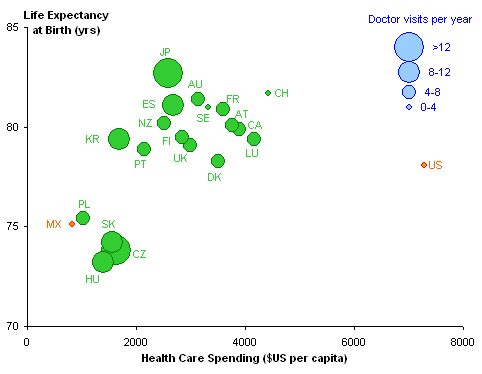
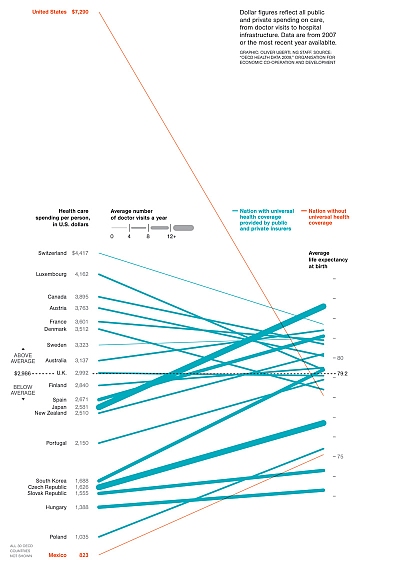
Graphing The Cost of Health Care


Great post on charting cost and outcomes on healthcare in various countries here.. 

The New Chart

The best way to show correlation between two variables is in an XY chart. I got into Chart Busters mode, and plotted X=spending and Y=life expectancy in the following chart. The US and Mexico are colored differently to highlight their non-universal-coverage status, and data points are sized to reflect the number of doctor visits.

Treat Me, but No Tricks Please

My doctor at the Hospital for Special Surgery in New York, Joseph Feinberg, seems to share my opinion. “Very often, I think the hot packs, cold packs, ultrasound and electrostimulation are unnecessary,” he said, adding, “For sure, in many cases these modalities are a waste of time.”
So has physical therapy been tested for garden-variety sports injuries like tendinosis? Or is it just accepted without much question by people who urgently want to get better?

New Happiness Research From The UK

There’s a new research study out of the UK on what makes people happy, and it has some interesting results.

Thursday, January 07, 2010

UPI's top 50 images of 2009

Pakistani internally displaced children queue for food at a makeshift camp in Swabi, Pakistan, on May 25, 2009. Pakistan's military said Monday it was facing "stiff resistance" as it battled to wrest Swat valley out of Taliban hands, in an offensive that has now scattered 2.38 million civilians. (UPI Photo/Sajjad Ali Qureshi)


UPI 2009 Top 50 News Pictures (50 images)

Cheap Mobile Calls, Even Overseas

What my parents did not realize was that they could have nearly eliminated those charges if they had set up their (in this case) iPhone and BlackBerry to take advantage of mobile Internet calling services: That $1.29-a-minute charge would have gone down to a much more reasonable 2.4 cents a minute (or nothing at all if they were on a Wi-Fi network).

10 Ways to Cut Your Travel Costs This Year

Here are 10 simple steps you can take to help cut your travel costs in 2010.

Blame It on the Brain

The latest neuroscience research suggests spreading resolutions out over time is the best approach.

Given its limitations, New Year's resolutions are exactly the wrong way to change our behavior. It makes no sense to try to quit smoking and lose weight at the same time, or to clean the apartment and give up wine in the same month. Instead, we should respect the feebleness of self-control, and spread our resolutions out over the entire year. Human routines are stubborn things, which helps explain why 88% of all resolutions end in failure, according to a 2007 survey of over 3,000 people conducted by the British psychologist Richard Wiseman. Bad habits are hard to break—and they're impossible to break if we try to break them all at once.
(..)
There's something unsettling about this scientific model of willpower. Most of us assume that self-control is largely a character issue, and that we would follow through on our New Year's resolutions if only we had a bit more discipline. But this research suggests that willpower itself is inherently limited, and that our January promises fail in large part because the brain wasn't built for success.
(..)
Since the most popular New Year's resolution is weight loss, it's important to be aware that starving the brain of calories—even for just a few hours—can impact behavior. Skipping meals makes it significantly harder to summon up the strength to, say, quit cigarettes. Even moderation must be done in moderation.

The final piece of the willpower puzzle is distraction. Research by Walter Mischel at Columbia University and others has demonstrated that people who are better at delaying gratification don't necessarily have more restraint. Instead, they seem to be better at finding ways to get tempting thoughts out of their minds.

A Tale of Two Flagella

I first remembered learning about dinoflagellates, and being fascinated by them, in college zoology...

They are the best of beings; they are the worst of beings. They are animals; they are plants. They are saviors; they are killers. They are predators; they are parasites. They are, in short, dinoflagellates — a large, diverse and eccentric group of (usually) single-celled organisms that are as celebrated as they are feared. And I hereby nominate them for Life-form of the Month: January.

(..)
Some dinoflagellates have eyes. Others give off light. Some, like plants, make energy from the sun; others, like animals, capture and eat their prey. Some do both. Funky.

But even if you’ve never seen a dinoflagellate and wouldn’t recognize one if it waved its flagella at you, you’ve probably come across them, for they impinge on our lives in two important ways, one good, one bad.
(..)

Most dinoflagellates are small — you need a microscope to see them — and even the biggest ones are no bigger than a piece of caviar. But they have gigantic genomes. Some dinoflagellates have genomes containing around 67 times more DNA than the human genome, and 10 times more than the most extravagantly endowed plants. That’s colossal. (Note that lots of DNA doesn’t necessarily mean lots of genes; in terms of gene numbers, it remains to be seen if dinoflagellates are exceptional.)

Even more peculiar is the way they store their DNA. The usual way is to wrap it around molecular spools known as histones. Dinoflagellates don’t have histones. Instead, their genome appears to exist as a liquid crystal matrix. Wackier still: dinoflagellates have unconventional DNA. In most organisms, DNA is composed of the molecules adenine, guanine, cytosine and thymine. Dinoflagellates often replace thymine with something called hydroxymethyluracil. It’s all most bizarre.

Wednesday, January 06, 2010

Study Says Women With Mate Get Heavier

It is widely known that women tend to gain weight after giving birth, but now a large study has found evidence that even among childless women, those who live with a mate put on more pounds than those who live without one.


The differences, the scientists found, were stark.

Where Did the Time Go? Do Not Ask the Brain


Either way, studies find, this biological pacemaker has a poor grasp of longer intervals. Time does seem to slow to a trickle during an empty afternoon and race when the brain is engrossed in challenging work. Stimulants, including caffeine, tend to make people feel as if time is passing faster; complex jobs, like doing taxes, can seem to drag on longer than they actually do.
And emotional events — a breakup, a promotion, a transformative trip abroad — tend to be perceived as more recent than they actually are, by months or even years.

Now researchers are finding that the reverse may also be true: if very few events come to mind, then the perception of time does not persist; the brain telescopes the interval that has passed.

Popular Drugs May Help Only Severe Depression

Some widely prescribed drugs for depression provide relief in extreme cases but are no more effective than placebo pills for most patients, according to a new analysis released Tuesday.


(..)
Taken together, previous studies have painted a confusing picture. On one hand, industry-supported trials have generally found that the drugs sharply reduce symptoms. On the other, many studies that were not initially published, or were buried, showed no significant benefits compared with placebos

Tuesday, January 05, 2010

Willpower as a muscle

Willpower as a muscle

Posted using ShareThis

Letter From London--My American Friends

The first thing I ever heard about Americans was that they all carried guns. Then, when I came across people who’d had direct contact with this ferocious-sounding tribe, I learned that they were actually rather friendly.
(..)
Granted, these visiting Americans often seem to have loud voices, but on closer examination, it’s a little subtler than that. Americans have no fear of being overheard. Civic life in Britain is predicated on the idea that everyone just about conceals his loathing of everyone else. To open your mouth is to risk offending someone. So we mutter and mumble as if surrounded by informers or, more exactly, as if they are living in our heads. In America the right to free speech is exercised freely and cordially. The basic assumption is that nothing you say will offend anyone else because, deep down, everyone is agreed on the premise that America is better than anyplace else. No such belief animates British life.

South Koreans experience what it's like to die -- and live again

Across South Korea, entrepreneurs are holding controversial forums aimed at teaching clients how to better appreciate life by simulating death. They use mortality as a personal motivator.
(..)
Across South Korea, a few entrepreneurs are conducting controversial forums designed to teach clients how to better appreciate life by simulating death. Equal parts Vincent Price and Dale Carnegie, they use mortality as a personal motivator for a variety of behaviors, from a healthier attitude toward work to getting along with family members.

Many firms here see the sessions as an inventive way to stimulate productivity. The Kyobo insurance company, for example, has required all 4,000 of its employees to attend fake funerals like those offered by Jung.

There's another motivation: South Korea has the highest suicide rate in the developed world.

Sunday, January 03, 2010

Pirate cash suspected cause of Kenya property boom

NAIROBI, Kenya – Property prices in Nairobi are soaring, and Somali pirates are getting the blame.

The hike in real estate prices in the Kenyan capital has prompted a public outcry and a government investigation this month into property owned by foreigners. The investigation follows allegations that millions of dollars in ransom money paid to Somali pirates are being invested in Kenya, Somalia's southern neighbor and East Africa's largest economy.

Even as housing prices have dropped sharply in the United States, prices in Nairobi have seen two- and three-fold increases the last half decade.

Saturday, January 02, 2010

Dave Barry's year in review: 2009

Dave Barry's Hilarious Year End Review Here

To be sure, it was a year that saw plenty of bad news. But in almost every instance, there was offsetting good news:
BAD NEWS: The economy remained critically weak, with rising unemployment, a severely depressed real-estate market, the near-collapse of the domestic automobile industry and the steep decline of the dollar.
GOOD NEWS: Windows 7 sucked less than Vista.
BAD NEWS: The downward spiral of the newspaper industry continued, resulting in the firings of thousands of experienced reporters and an apparently permanent deterioration in the quality of American journalism.
GOOD NEWS: A lot more people were tweeting.
BAD NEWS: Ominous problems loomed abroad as -- among other difficulties -- the Afghanistan war went sour, and Iran threatened to plunge the Middle East and beyond into nuclear war.
GOOD NEWS: They finally got Roman Polanski.
In short, it was a year that we will be happy to put behind us. But before we do, let's swallow our anti-nausea medication and take one last look back, starting with. . . .link

Mammography Screening Is Saving Thousands of Lives, but Will It Survive Medical Malpractice?

There are some very important points made by Dr. Kopans here, especially near the end of  the article in which he discusses  the vagaires of human perception, standard of care, and expert witnesses..
uvealblues

RSNA, 2004
Screening mammograms are saving lives, but the number of radiologists who are willing to read mammograms is decreasing because of their fear of being sued.

There have been recent efforts to highlight the cost of medical malpractice and to try to find ways to reduce these costs (1). However, it is not just the cost of malpractice insurance that is a problem. What I believe is being overlooked is the unjustified psychologic damage that is being inflicted on some physicians, as well as the failure of the legal system to recognize science, with particular emphasis on the detection of breast cancers with mammography. Screening mammograms are saving lives, but the number of radiologists who are willing to read mammograms is decreasing because of their fear of being sued.
Related Posts with Thumbnails

ShareThis